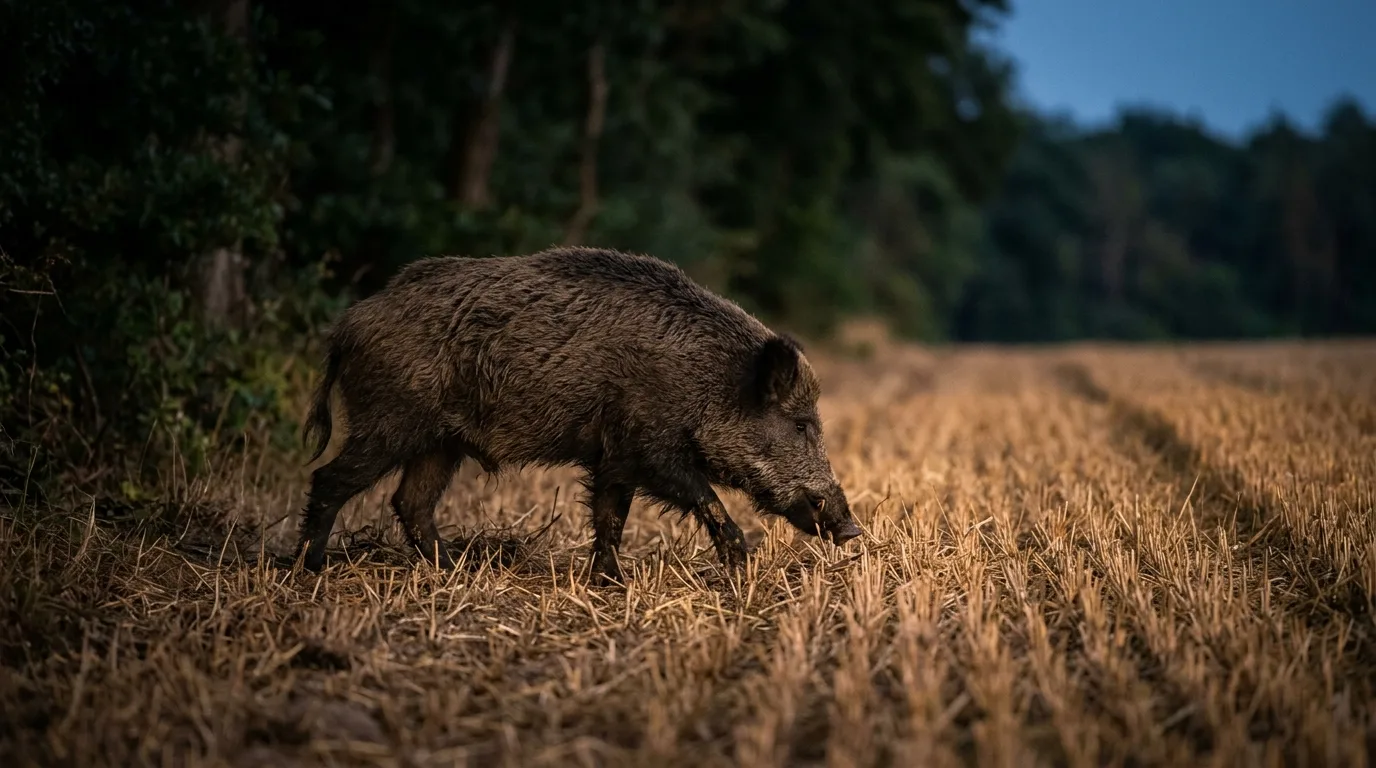
Put a camera on a feeder, a wallow, or the edge of a cornfield where boar are tearing up the ground, and a pattern shows up fast in the timestamps: the pigs come after dark. Not "mostly" after dark in a hand-wavy way — overwhelmingly. In one Argentine camera study, more than three out of four boar detections fell between 9 p.m. and 3 a.m., and barely one in ten landed in daylight. That's the headline answer, and it holds from the oak forests of Germany to the cattle country of Queensland: wild boar are strongly nocturnal animals with a hard lean toward the hours around midnight, sharpened into peaks at dusk and dawn.
But "nocturnal" isn't a fixed law the pig is born obeying. It's a setting the animal dials up or down in response to who's hunting it, how hot the day is, and how long the night runs. Understand the dial, and you stop guessing when to hunt or where to set a trap — you start reading it off the data.
Here's the part you can act on before you finish your coffee. Across the best GPS and camera datasets we have, boar concentrate their movement at night, with the strongest pull toward the middle of the night and reliable bumps at the twilight edges around sunrise and sunset. What changes from one property to the next isn't whether boar are nocturnal — it's how nocturnal, and that's set by pressure, heat, food, and daylight. The skill isn't memorizing a magic hour. It's knowing which of those forces is bending the curve where you're standing.
Wild boar aren't born nocturnal — they're taught it, mostly by us, one disturbance at a time.
Let me walk through what the data actually says, and where it's messier than the internet wants it to be.
The baseline: night animals, with twilight edges
Start with the raw timestamps, because they're remarkably consistent across continents.
In the rangelands of central Argentina, a camera-trap effort spanning roughly 7,000 trap-days found boar "mostly nocturnal, with more activity between 21:00 and 3:00 and a peak around midnight" — 76.7% of independent detections fell in that window, against just 11.3% in daylight, most of that in the early morning. In northern Germany, a behavioral study built from camera video clips concluded the animals were "crepuscular and nocturnal because their main activity was between 17:00 and 08:59," with movement maxima landing at 10 p.m. and again at 3 a.m.. Cross to a German biosphere reserve studied with 53 cameras over 14 months and you get the same verdict: "primarily nocturnal, with diurnal activity occurring dominantly during the summer months".
Notice the two layers in those findings. There's the broad nocturnal block — pigs are up and moving through the dark — and then there are the sharper spikes riding on top of it, right at the seams of the day. The Belgian study pins the activity peaks to "sunrise and sunset". The German behavioral work shows foraging maxima at dusk (5 p.m., when boar hit a salt lick) and again late at night (10 p.m., the heavy rooting and pawing). A boar's day, in other words, isn't a flat shelf of nighttime activity. It's a curve that ramps up hard at last light, runs through the night with a midnight emphasis, and tapers off around first light as the animals head back to cover.
How much of the 24-hour cycle is that, in total? Less than you might guess, because a lot of the night is spent resting too. The German telemetry study measured boar active for about 41% of the full day on average. Camera-based estimates in the German reserve put daily activity at 7.5 to 11 hours, and an Italian camera study landed near 11.8 hours of movement activity a day. The number that matters for the rest of this article is the next one: that activity total isn't fixed. It rises and falls with the seasons, the temperature, and — more than anything else — with how much the pigs feel watched.
What makes them nocturnal: it's mostly us
Here's the thing the timestamps alone won't tell you. Wild boar aren't obligate night animals the way an owl is. Given a quiet enough place, they'll happily move in daylight. The strong nocturnality we measure almost everywhere is, to a large degree, a response to human disturbance — and the cleanest proof comes from studies that varied the pressure and watched the curve move.
The German telemetry study was built around exactly this question. Researchers tracked boar across a gradient from hunting-free zones to areas under standard hunting pressure, and the result was unambiguous: "daylight activity was higher in the hunting-free zone than in the standard-hunting zone." More than that — "large areas with low disturbance levels promoted activity during daylight more than smaller areas with an intermediate disturbance regime". Give boar a big enough refuge with little hunting, and they relax into the daytime. Squeeze them, and they vanish into the dark.
The Belgian camera study caught the spatial side of the same behavior. There, boar split their world by the clock: "during the day, wild boar utilized areas in the centre of the forest, possibly to avoid human activities during daytime," and "during the night, they foraged near (or in) agricultural fields". The day and night maps were essentially uncorrelated — different ground for different hours — and human activity in the forest "largely occurred when boars were inactive". The pigs had arranged their lives to never be where the people were when the people were there.
This is the single most useful idea in the whole topic, so let me state it plainly. A field that boar are wrecking but that no camera ever catches them in by day isn't a field boar avoid. It's a field they visit at 2 a.m. The animal didn't disappear; it shifted its schedule to the hours you're not watching. Institutional reviews of feral swine behavior reach the same conclusion — sustained hunting pressure drives boar to "exhibit increasingly nocturnal behavior", and in Finland, where boar live under hunting and human disturbance at the cold edge of their range, movement is "restricted to the night hours," with daytime resting sites and nighttime feeding excursions cleanly separated.
A field boar wreck but never show in by day isn't a field they avoid — it's one they visit at 2 a.m.
There's an honest caveat worth keeping. Not every form of human presence rewrites the schedule, and not all disturbance is equal. The German reserve study found that formal management zoning — drawing a line between a strictly protected core and a more heavily used transition zone — had "little impact on wild boar behavior"; occupancy stayed high and activity curves looked similar across zones. The lesson isn't that disturbance doesn't matter. It's that hunting — being shot at — is a sharper teacher than a hiking trail or a zoning boundary. Where the pressure is lethal and sustained, boar go nocturnal and stay that way. Where it's just people walking around, they often shrug.
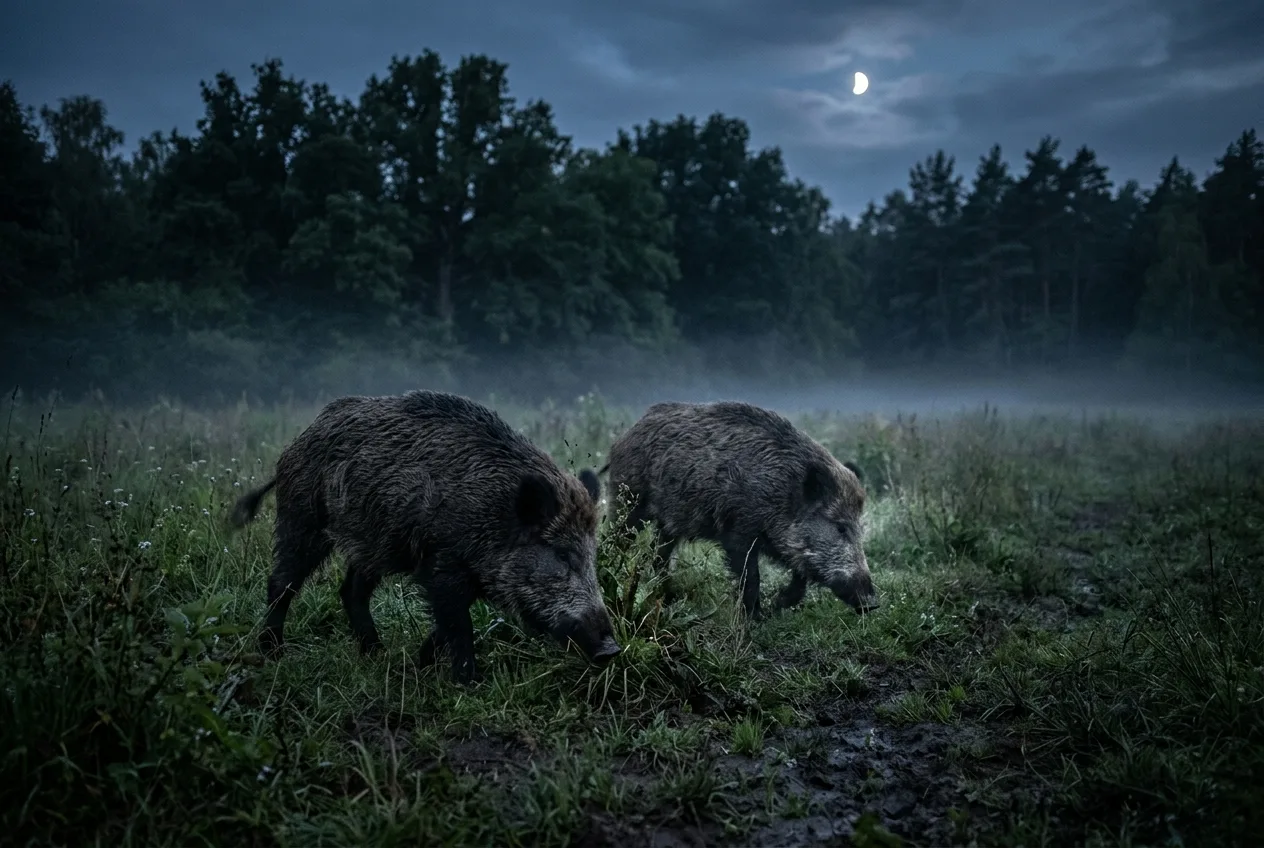
Heat is the other big lever
The second big driver has nothing to do with predators and everything to do with physiology: wild boar can't handle heat, and it shapes their clock as firmly as hunting does.
The reason is simple and a little surprising. Pigs don't sweat. "Feral pigs cannot tolerate heat because they lack sweat glands," the Australian management guide notes; "they need access to reliable water and shade to cool down in hot conditions". Texas extension specialists make the same point — feral hogs are "very poor thermoregulators," and in warm conditions they "use shaded areas, feed nocturnally, or wallow in mud" to keep their temperature down. Nighttime isn't just safer; on a hot day it's the only time a boar can comfortably be on its feet at all.
The telemetry confirms it with numbers. In the German study, "between temperatures of 0 °C and 17 °C, the probability of active behaviour was high," but "at higher temperatures, wild boars strongly reduced their activity". The Argentine work was run through a summer with daytime highs above 30 °C, and the authors concluded the boar "preferred being active during nighttime to avoid high daytime temperatures". Heat doesn't just nudge the curve — above a threshold it slams the door on daytime movement.
That threshold also helps explain a seasonal twist. Across a six-state US dataset, wild pig behavior was "primarily nocturnal during the summer months, but tends to be more diurnal during the fall, winter, and spring months," with overall movement reduced in summer. The German reserve mirrored it: nearly all of the boar's daylight activity showed up "during the summer months" — which sounds backwards until you remember the nights are short then, so a strictly nocturnal animal is forced to borrow a little daylight just to get enough hours in. Activity scaled with the length of the night. The animal is threading two needles at once: avoid the heat, avoid being seen, and still find time to eat.
It's worth flagging that the heat relationship isn't a straight line. The six-state US analysis found a "concave" relationship between temperature and daily movement — boar move most at moderate temperatures and back off at both the hot and the cold extremes. Bitter cold suppresses movement too, not just heat. The sweet spot for a moving pig is mild.
Season, sex, and how far they roam
Activity timing is one axis. The other is space — how far boar travel and how big a patch they call home — and here the pattern splits cleanly by sex and by season.
The clearest picture comes from an Italian GPS study of 28 boar in the Tuscan Apennines. Day to day, the sexes covered similar ground — males averaged 5.86 km a day, females 5.13 km. But the seasonal rhythm differed sharply. Males held a roughly constant daily distance year-round but blew their home ranges wide open during the autumn–winter rut: monthly ranges around 9 to 11 km² in the breeding months against just 2 to 3 km² in summer — "about three times larger". Females did the opposite. Their home ranges stayed stable across the year, but they traveled shortest in spring, around the food peak and the birth period, drawing in tight when there were piglets to mind. A boar in the rut is a wandering animal; a sow with a litter is a homebody.
That sex split shows up again in the management literature, in rounder numbers. The Australian guide gives family groups of sows, piglets, and juveniles "more limited home ranges (2–20 km²)," while solitary boars "range between 8–50 km²". An Australian GPS study of 59 feral pigs across four sites found home-range size "highly variable" and significantly driven by sex, site, and body mass — bigger pigs, bigger ranges — but, interestingly, not by season or year at those sites. So the rut-driven swing the Italian study saw isn't universal; in some populations sex and body size dominate and the seasonal signal washes out.
Then there's latitude, which scrambles the numbers entirely. At the cold northern edge of the boar's range in Finland, average home ranges ran to 87 km² by minimum convex polygon — vastly larger than the 4 to 52 km² typical of southern European studies. Resources are thin and scattered up there, so a boar has to cover more ground to make a living, even though the animals are otherwise "relatively sedentary" and don't disperse far. The practical takeaway: a "normal" boar home range is a local quantity. Don't import a Mediterranean figure into a boreal forest, or a research telemetry estimate into a popular-press number — some agency profiles cite male territories as large as 300 km² and sow ranges of 230 km² as upper extremes, far above what most GPS collars actually record.
A "normal" boar home range is a local quantity — a Mediterranean number means nothing in a boreal forest.
Here's a compact view of how the spatial picture shifts:
| Population / setting | Typical home range | What drives it |
|---|---|---|
| Italy, Tuscan Apennines (GPS, 28 boar) | Males ~5 km², females ~2.6 km² monthly; males ~3× larger in the rut | Sex and the autumn–winter rut |
| Eastern Australia (GPS, 59 pigs, 4 sites) | Highly variable; significantly set by sex, site, body mass — not season | Sex, site, body weight |
| Australia, general guidance | Sows 2–20 km²; solitary boars 8–50 km² | Sex and social structure |
| Finland, northern range edge (GPS, 17 boar) | ~87 km² MCP — far larger than southern studies | Sparse resources at high latitude |
One more seasonal note for anyone managing pigs rather than hunting them: the season changes how catchable boar are. A Texas study reasoned that movement peaks plus a lean natural-food period make winter trapping in open grassland the most productive window — the pigs are moving and hungry. Time your effort to when the animals are working hardest for food, and you meet more of them.
The sounder: a social clock, not a solo one
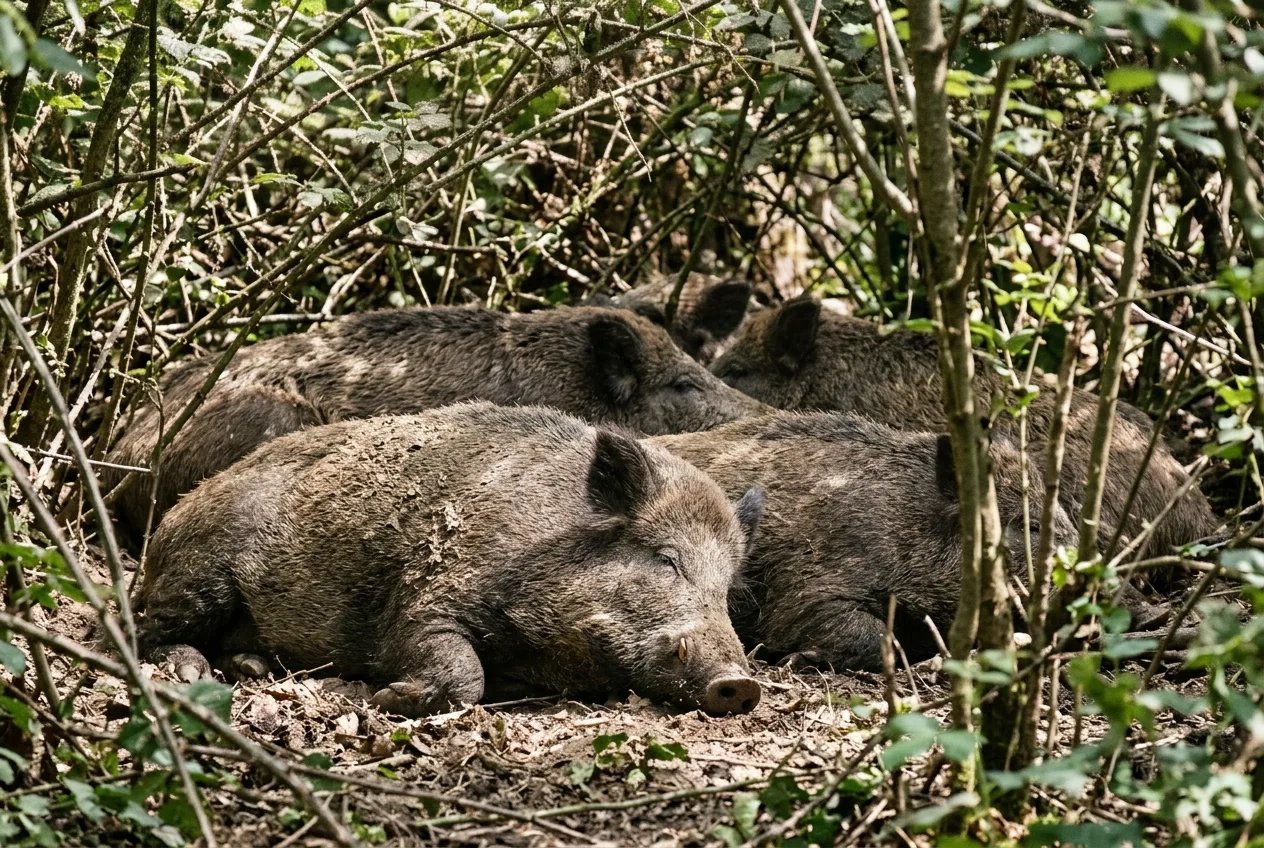
It's easy to talk about "a boar" as if activity were an individual decision. For most of the population, it isn't. Females and young live in tight family groups — sounders — and that social structure governs how and when they move.
These groups are kin-based and durable. A Polish study using telemetry and genetics in the Białowieża forest found female associations "particularly long-lasting": 81% of female–female bonds were potentially lifelong, and group members overlapped their home ranges far more with each other than with outsiders. Sounders are typically modest — the Polish work estimated true social-unit size around 8 individuals — though they can swell in good conditions. Texas extension describes the same structure from the other side of the world: "multi-generational groups of related individuals called sounders," ranging from 2 up to 50 animals, banding together to protect their young. Agency field guides across the US and UK note the same sows-and-young grouping as a basic fact of the animal.
Males are the loose cannons. In the Polish network, male–male associations were "dynamic and short-lived," with most breaking down within a day — boars drift, especially the solitary adults, while the sounder holds its shape. That's the social backdrop to the rut-season ranging the Italian study measured: a boar widening his range across the winter is a male circulating among sounders, while the sows he's looking for stay put around food and shelter.
For anyone watching a feeder or a trail, this matters. When a sounder commits to a spot, you'll often get the whole group moving on roughly the same nocturnal schedule — sows, juveniles, piglets, arriving and leaving together. A lone, range-shifting boar is the harder, less predictable visitor, and more likely to be the one that shows up out of rhythm.
Moon and weather: where the evidence gets thin
No boar-activity article is complete without the question every hunter asks: does the moon matter? Honest answer — the evidence is thinner and shakier than the confidence with which it's usually asserted, and I'd treat it as a minor factor at most.
The institutional reviews do report a moon effect. A Texas A&M Natural Resources Institute synthesis notes that boar activity is "highly influenced by temperature, humidity, and phases of the moon," citing a 2017 Italian study, and even reports an optimal atmospheric-pressure band for movement. The intuition is reasonable: brighter nights might let boar move more, or move less, depending on whether light helps them forage or exposes them to risk. But the single most on-topic primary study on lunar light could not be independently verified for this piece, and the claim reaches us secondhand through a review rather than from a paper we could read in full (see Editor notes). So I'm not going to dress up a moon-phase rule as settled science. If the moon nudges boar movement, it's a small effect sitting underneath the two big ones — pressure and heat — that the primary GPS and camera data show clearly and repeatedly.
Weather and barometric pressure fall in the same bucket: plausible, cited in the secondary literature, but not the lever that nocturnality and the seasonal shift are. If you want to predict when boar move on your ground, watch the temperature and the hunting pressure first. The moon is a footnote, not a forecast.
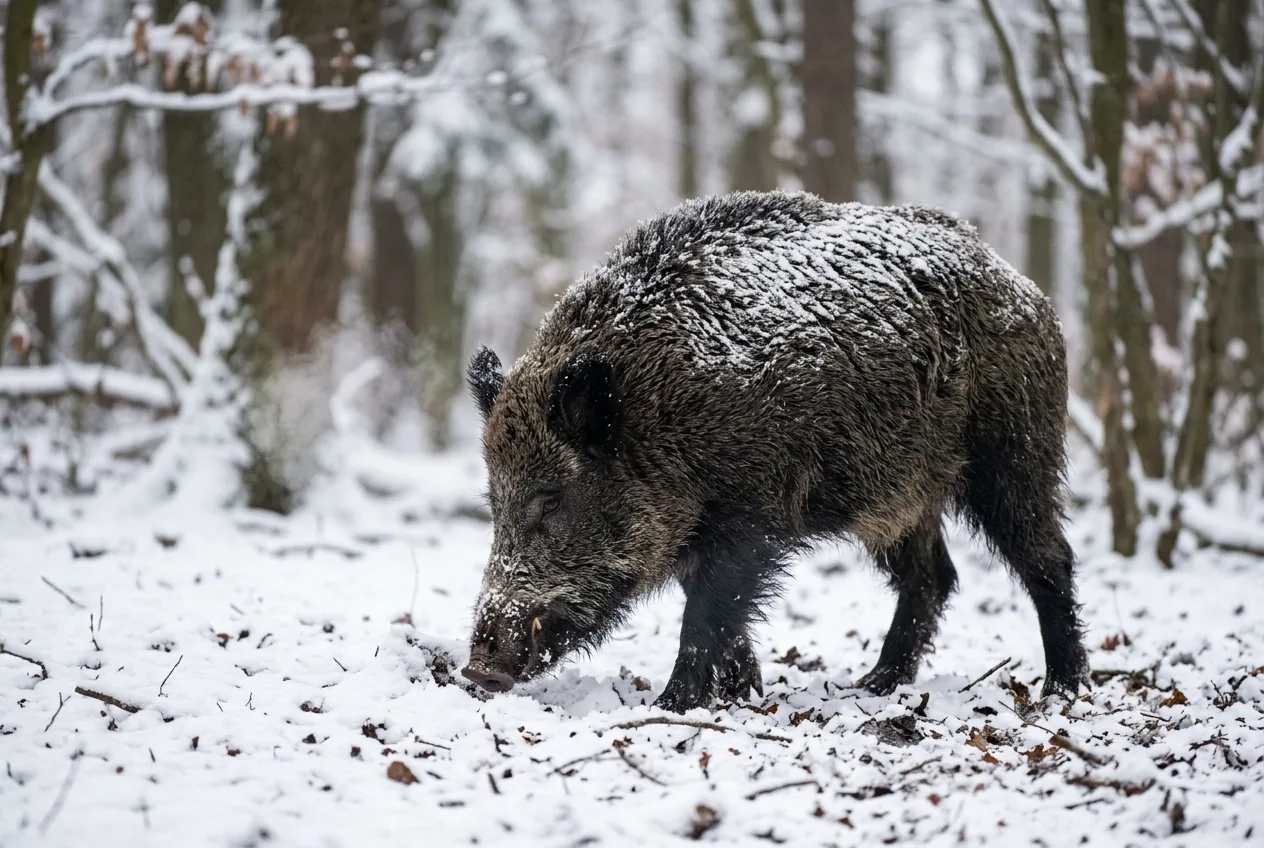
Reading the night off your own cameras
All of this converges on a practical point: the answer to "when are my boar active?" is sitting in the timestamps on your own photos, and it's specific to your property in a way no general rule can be.
Boar are, as one camera-trap study put it, "an elusive species with nocturnal activity patterns" — exactly the kind of animal that defeats direct observation but that a camera, running through the night on infrared, catches without ever spooking. The data you want is already being written: each photo carries the hour the pig walked by, and stacked over a few weeks those hours draw your herd's real activity curve — where the dusk spike lands, how deep into the night the rooting runs, whether a cold front pulled any movement into daylight. Read the temperature stamped on those same frames against the timing and you can watch the heat-avoidance relationship happen on your own dirt: hot week, dead daylight, everything crammed into the small hours.
The general rules in this article tell you what to expect: nocturnal, midnight-heavy, twilight peaks, shut down by heat, pushed darker by pressure. Your own camera data tells you how those rules are bending on your ground this week. Hunt the gap between the two, and you'll be standing where the boar are while everyone else is still arguing about the moon.
Frequently asked questions
When are wild boar most active during the day?
They're not — wild boar are strongly nocturnal, with activity concentrated through the night and a peak around midnight. The most active windows are the twilight edges: a sharp ramp-up at dusk and another bump near dawn, around sunset and sunrise. Genuine daytime movement mostly happens in places with little hunting pressure, or in summer when short nights force it.
Are wild boar always nocturnal, or can they be active in daylight?
They can absolutely move in daylight — nocturnality is largely a learned response to being hunted, not a hard rule. In hunting-free or low-disturbance areas, boar show clearly more daylight activity than in hunted areas. The heavier and more lethal the human pressure, the more strictly nocturnal they become.
Why do wild boar avoid being active in the heat?
Because they can't sweat. Boar lack functional sweat glands and are poor at shedding heat, so they rely on shade, water, wallowing, and feeding at night to stay cool. Telemetry shows activity stays high up to about 17 °C and drops sharply above that, which is why hot summer days push almost all movement into the dark.
How does the season change wild boar activity?
Boar are most nocturnal in summer and add daytime movement in fall, winter, and spring. Nightly activity also scales with the length of the night, so the animals are working a longer shift in winter. Males roam much wider during the autumn–winter rut, while sows stay tight around food and young.
How big is a wild boar's home range?
It depends heavily on sex, body size, and latitude. In southern Europe, sounders of sows hold ranges around 2–20 km² and solitary boars 8–50 km², with males expanding roughly threefold in the rut. At the cold northern edge of the range in Finland, average ranges reach about 87 km² because resources are so spread out.
Does the moon affect wild boar movement?
Possibly, but it's a minor and poorly verified factor compared with heat and hunting pressure. Secondary reviews report that moon phase, temperature, and humidity all influence boar activity, but the primary lunar-light evidence is thin and reaches us secondhand. If you're predicting boar movement, weigh temperature and pressure first and treat the moon as a footnote.