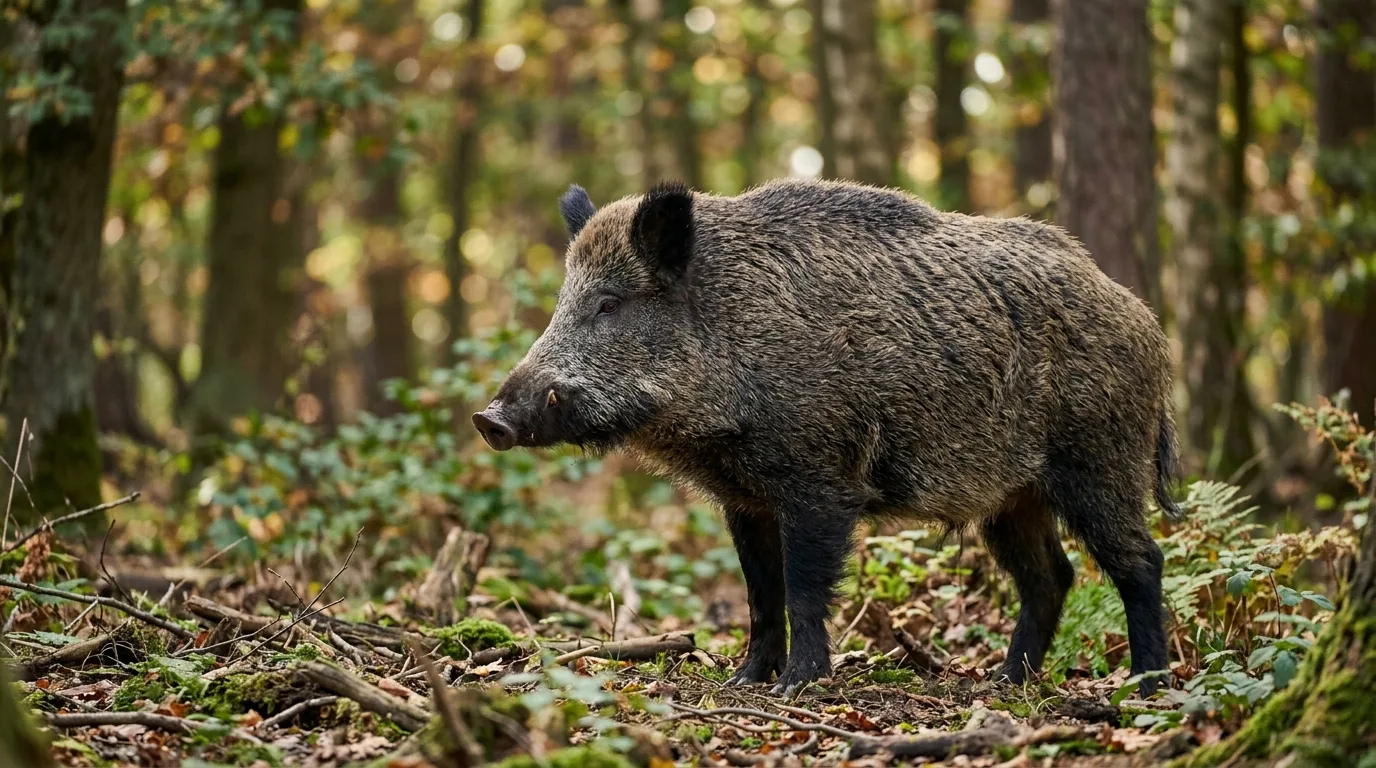
A black, bristly pig walks past your camera at the edge of a wood. In Georgia you'd call it a feral hog. In the Forest of Dean you'd call it a wild boar. In Queensland it's a feral pig, and across the Canadian prairies someone's already calling it a "super pig." Four names, four continents, one animal looking back at the lens — and a lot of confusion about whether they're even the same thing.
Here's the short answer, and it settles most of the argument before it starts: wild boar, feral hogs, and the hybrids in between are all the same species, _Sus scrofa_. The domestic pig is just a domesticated wild boar, and when domestic pigs go wild they "can quickly revert to the habits and physical characteristics of their wild ancestors". So "wild boar vs feral hog" was never a question about two different animals. It's a question about ancestry and appearance — how much wild-boar blood is in the animal, and how much of that you can read off a photo.
The honest, slightly deflating truth is: less than you'd hope. You can often make a good guess. You can sometimes say "that one's clearly close to a pure wild boar" or "that one's an escaped farm pig that hasn't been wild long." But the thing people most want — a clean field test that sorts true boar from feral hog from hybrid — doesn't exist, because the genetics that would settle it have been blending for as long as pigs have been domesticated. Let's walk through what the cues actually tell you, and where they quietly mislead.
One species, many names
Start with the fact that frames everything else. A US state wildlife agency puts it as plainly as anyone: "no matter what you call them — feral swine, wild boar, Eurasian wild boar, and all hybrids between them — are all the same species, _Sus scrofa_. All domestic pig breeds are descendant from the Eurasian wild boar". Ireland's national risk assessment says the same in drier language: "_Sus scrofa_, in origin a wild boar, is a single taxonomic entity," and the wild boar is "the direct ancestor to the domestic pig, with which it shares a close genetic affinity and can hybridise with".
That hybridising part matters, because it's not a one-way door. Wild boar and domestic pigs "can interbreed and produce fertile hybrids," and those hybrids "can successfully breed with wild boar and domestic pigs or with other hybrids". Generation after generation, in any direction. There's no genetic wall keeping the "wild" and "domestic" forms apart — there never has been.
Wild boar, feral hogs, and every hybrid between them are one species wearing a dozen regional names.
So the names are really a map of geography and history, not biology:
- Wild boar — the term used across Europe and Asia, where the animal is native. The native range runs "from Western Europe to the Maritime Territory of eastern Siberia," down through North Africa, India, Indo-China, Japan and the Greater Sunda Islands. Confusingly, in places where boar were wiped out and later came back, the "wild boar" you see are themselves feral: Britain's population descends from farm escapes and illegal releases, and is officially classed as free-roaming feral wild boar. So even in their native range, "wild boar" and "feral" aren't always different things.
- Feral hog / feral swine / wild pig — the usual US terms. American free-ranging pigs "include wild boar, escaped domestic pigs, and hybrids of the two," with an estimated six million of them, roughly half in the South. Texas alone stacks up nicknames: "European wild hogs, wild boars, razorbacks, pineywoods rooters, woods hogs" — all the same species.
- Feral pig — the standard Australian term, where every wild pig descends from escaped domestic stock brought by European colonists.
- "Super pig" — the nickname attached to Canada's wild pigs, which can be Eurasian boar, domestic, or hybrid, and where hybrids of large commercial breeds "can get twice as large" than pure wild boar.
Even the formal science is unsettled about how many kinds of wild boar there are. The IUCN's wild pig specialists note that "anything from 4 to 25 subspecies have been recognized by different authors". If the experts can't agree on the subspecies, you shouldn't feel bad about squinting at a trail-cam photo.
One quick aside for hunters in the American Southwest: the javelina, or collared peccary, is not a feral hog at all. It "belongs to a different family" entirely — different species, genus, and family. It just happens to look vaguely pig-shaped. Don't let it muddy your ID.
The coat: your fastest read, and its limits
If you only get one good look, look at the coat. It's the cue that most often separates "this has real wild-boar in it" from "this is an escaped farm pig" — as long as you remember it's a strong hint, not a verdict.
The wild-boar coat has a specific, recognisable look. Contrary to the old myth that wild boar are jet black, "pure wild boar are not solid black". The classic adult pattern is grizzled: "a coat of light brown to black with white or tan distal tips on the bristles," with the face, cheeks and throat "grizzled in appearance with white-tipped bristles" and lighter undersides. The IUCN describes the same thing — coarse and bristly, "brown to almost black, usually turning grayish with age," with face, cheeks and throat "slightly grizzled with whitish hairs". Picture a salt-and-pepper, fieldy brown-grey, not a uniform colour. Oklahoma's guide adds a useful detail: on a pure Russian boar, "its legs, ears and tail are darker than the rest of the coat".
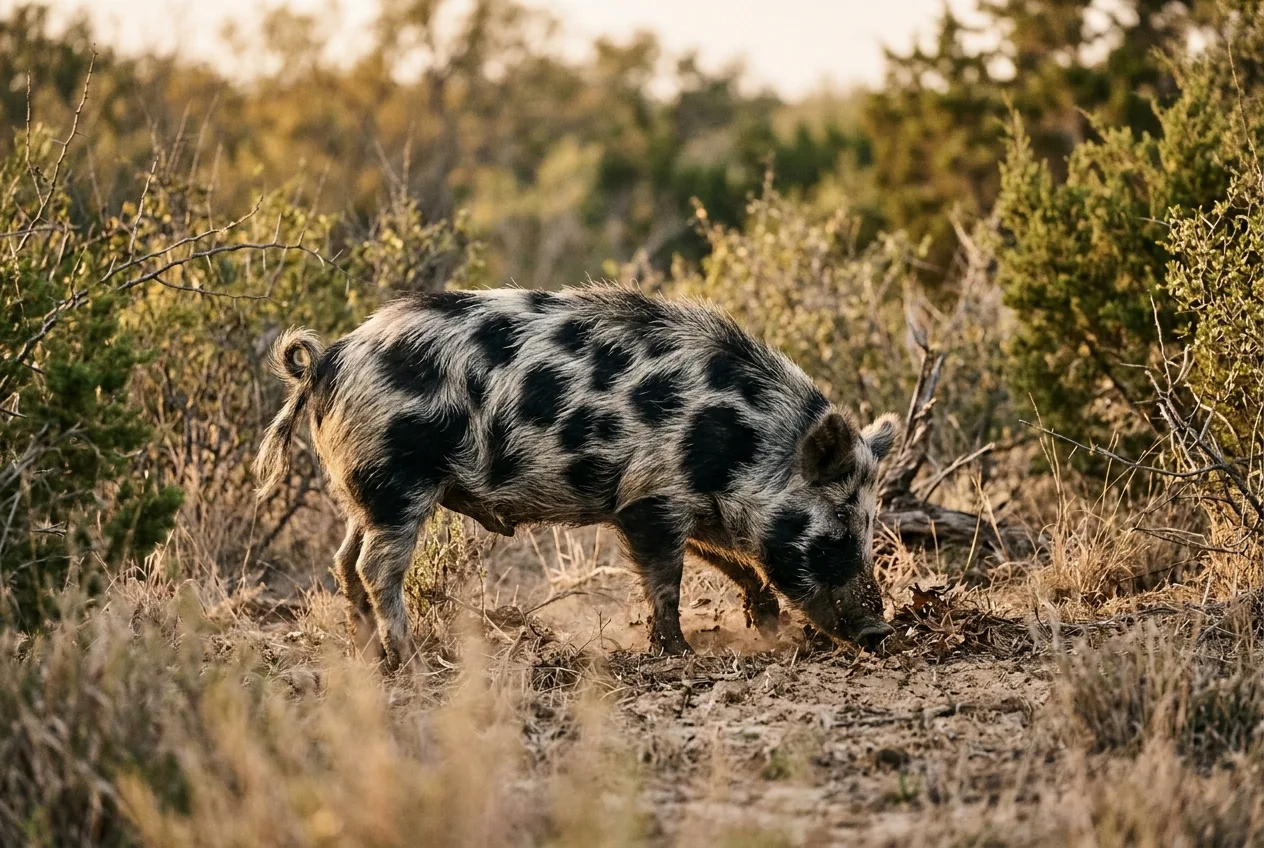
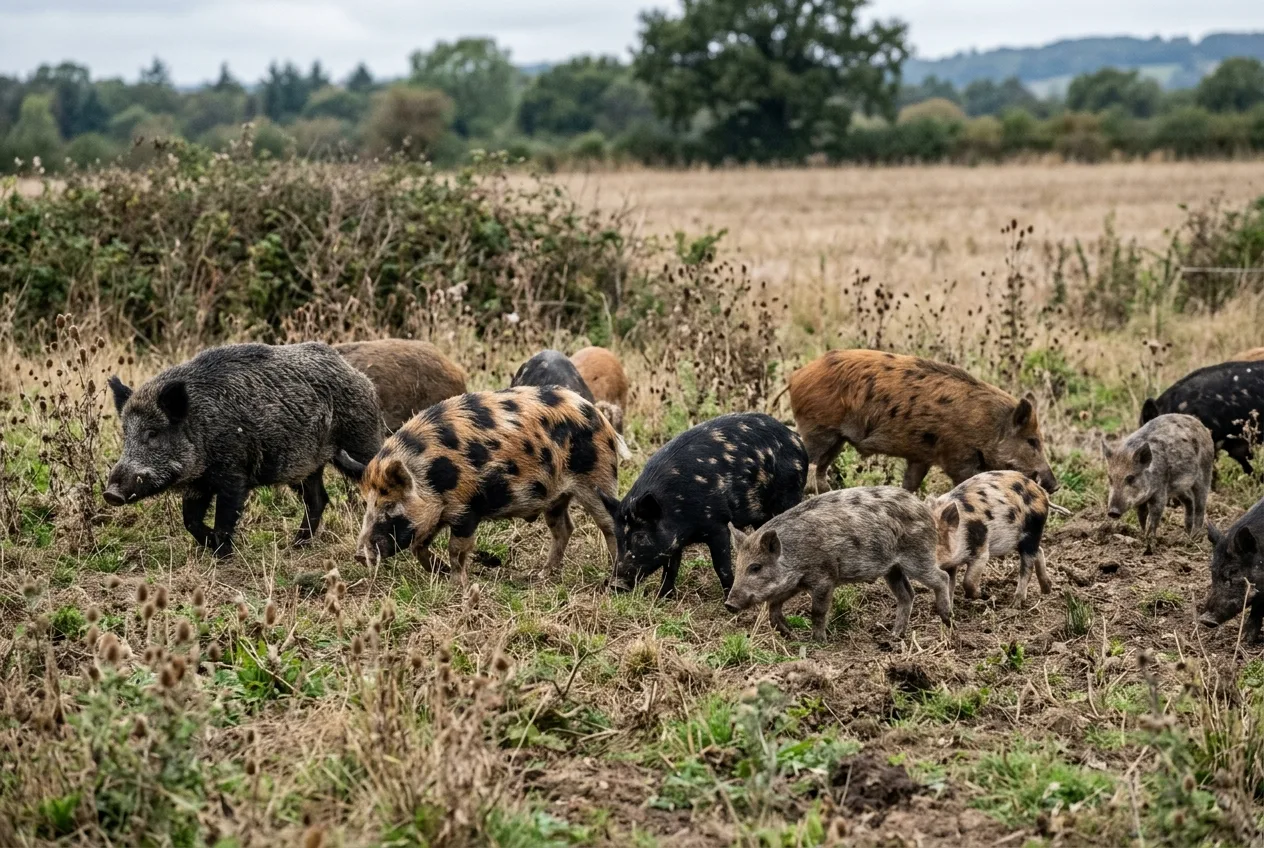
Feral domestic pigs, by contrast, throw the whole paintbox. Their coat "can vary from solid black, brown, blond, white or red to spotted... or belted," where a belted hog "has a white band across the shoulder and forelimbs". Texas A&M's tally: solid black is the most common, but they're also "brown, red, white, spotted, belted... or have rare blue or gray roan patterns". Solid black, bright white, pink-and-black spots, a Hampshire-style white belt — those are domestic signatures.
There's a real genetic reason for that split, and it's worth knowing because it tells you why the coat is informative at all. The gene that controls much of pig coat colour (MC1R) evolved in opposite directions in the wild and on the farm. In wild boar, "all mutations found among wild boars were silent" — they didn't change the coat — because "strong purifying selection in the wild... maintains camouflage coat color". A wild boar that turns up white or piebald gets eaten; nature keeps grinding the coat back to camouflage. On the farm, the reverse: "nine out of ten mutations found in domestic pigs altered the protein sequence, thereby drastically transforming the resulting coat color," because early farmers actively "selected pigs with novel coat coloring". Black, white, spotted, belted — those are the fingerprints of human selection.
A solid-black, white, spotted, or belted coat is the fingerprint of the farm; a grizzled brown-grey coat is the signature of the wild.
So a spotted or belted free-ranging pig is showing you domestic ancestry in its coat. Just don't flip that into a false certainty. A spotted coat doesn't prove an animal is "not a wild boar" — that domestic colour gene can introgress into wild populations, and "spotting patterns have even been reported in pure wild boar populations". The coat shifts the odds. It doesn't close the case.
Bristles: length and coarseness, on a gradient
Get close enough (or get a sharp enough photo) and the hair itself tells a story — but as a gradient, not a switch. Across the board, wild and feral pigs share a coat that's sparsely covered with stiff bristle hairs over a fine undercoat, often with "a mane of bristles extending from their neck to the middle of their back". That bristly mane, raised when the animal is agitated, is the origin of the name "razorback".
The useful signal is bristle length and thickness, which sort roughly by ancestry. Oklahoma lays out the gradient cleanly: a feral hog's bristles are "generally longer than a domestic hog, but shorter than the hybrid or pure Russian"; the Russian boar's are "the longest of the three types"; and hybrids fall in between, "longer than the feral, but shorter than the Russian," while carrying "the smallest bristle shaft diameters". Texas A&M agrees the pure Eurasian's bristles "are the longest and thickest of all types". So: longest, coarsest hair leans wild boar; short, sparse hair leans recently-domestic.
One popular "tell" you should drop is split bristle tips. Texas A&M notes the pure Eurasian's bristles "usually have multiple splits at the tips" — but the same guide says feral hogs' bristles "split at the tips" and hybrids' bristles "have split tips" too. In other words, splitting shows up across all three. The deeper synthesis is blunter still: the idea that split ends are taxonomically meaningful "was later disproved". Frayed tips just mean a bristle that's seen some wear. Judge length and coarseness; ignore the split.
Striped "humbug" piglets: the cue that fools everyone
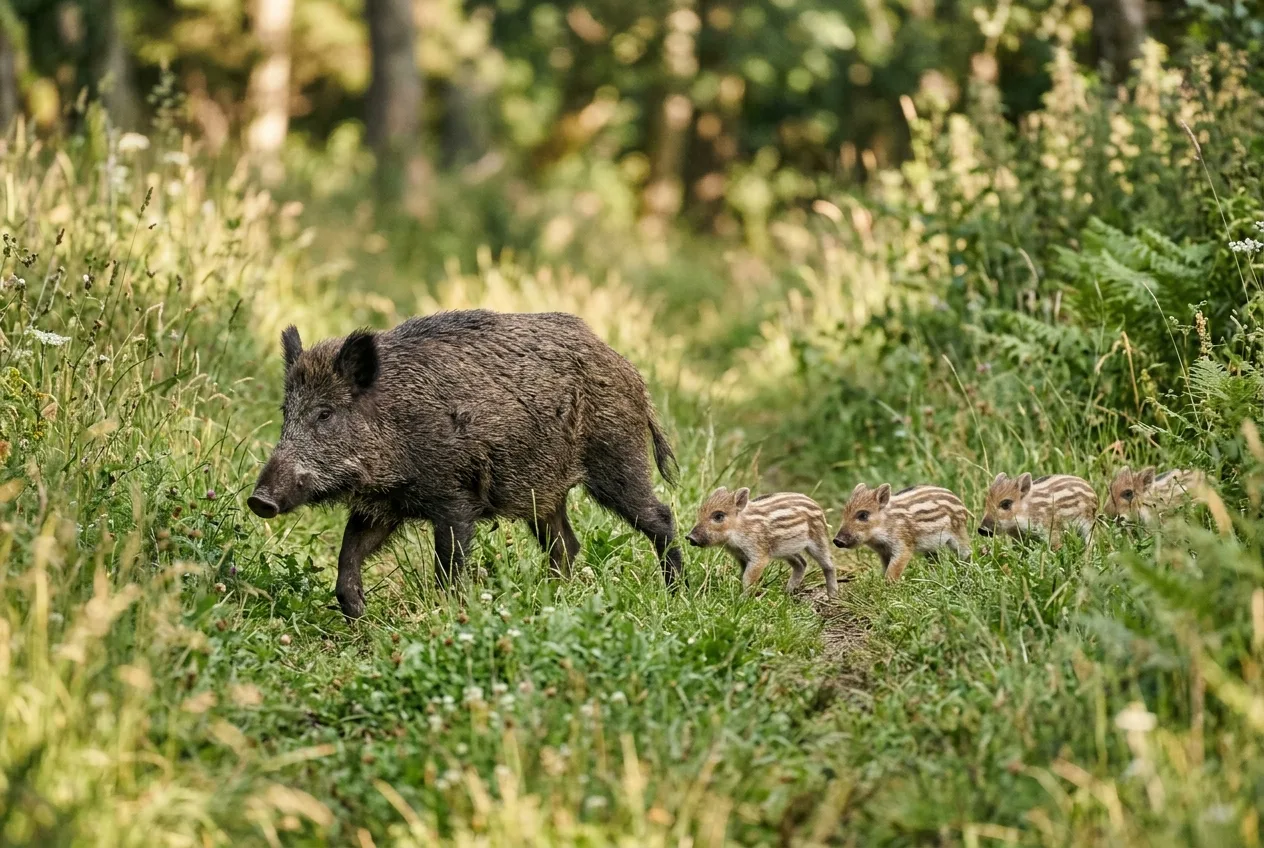
Few wild-pig images are as charming, or as routinely misread, as a litter of striped piglets. In Britain they're nicknamed "humbugs" "because of their stripy coats," with "longitudinal ginger-brown and cream stripes across their body for camouflage". The pattern is sometimes called "watermelon-striped" or "chipmunk-like" — a pale base coat with a dark spinal stripe and "three to four brown irregular longitudinal stripes" running down the body.
It's tempting to treat those stripes as a wild-boar badge. Don't. The striped coat is not diagnostic, full stop. It "is found in all of the subspecies of Eurasian wild boar, wild boar x feral hog hybrid populations, and in some feral hog populations". Newborn wild boar "and their hybrid offspring usually have camouflage coat colors with juvenile stripes". Texas A&M puts the warning in one line: "Juveniles of all types of wild swine may have striped patterns that disappear as the hogs mature". And Oklahoma's is the cleanest of all — piglet stripes appear across all three types, making them "not a reliable method of identification".
What stripes _do_ tell you reliably is age, and that's genuinely useful for reading a photo. The fade is fairly consistent. The IUCN says the pattern "fades between the second and sixth month," with adult coloration reached at one year. A controlled study of wild boar × Duroc piglets pinned it down: "the juvenile stripes started to disappear at about 70 d, and stripes were not distinguished with the naked eye at about 160 d" — call it four to five months. The big US synthesis brackets the same window: the striped coat "changes to the adult pattern... at between four to six months of age," after which wild boar and some hybrids pass through a reddish phase that lasts until about a year old.
Striped piglets tell you an animal is young — not that it's wild. Every kind of wild pig wears the humbug coat.
So if you catch a striped piglet on camera, you've learned its rough age, not its pedigree.
Body, snout, and tusks: the structural cues
Coat fades and varies; bone is steadier. The most reliable visible differences between the types are structural — head and snout length above all. When researchers measured hundreds of wild pigs to find which external dimensions best separated the three types, the winners were "snout and hind foot lengths". Snout length you can actually judge from a side-on photo.
True wild boar are long-headed and long-snouted. Eurasian boars "have longer legs, larger heads, longer snouts, and a larger head-to-body ratio than other feral hogs," plus "shorter, straighter tails". The skull itself is "elongate, especially in the proportional size of the rostral region" — the snout — and ends in a long, pointed head. A recently-escaped domestic pig, by contrast, often keeps a shorter, more "pushed-in" face. That long-snout-versus-short-snout read is one of your better cues from a single frame.
Here's the twist that makes the whole topic interesting: feral domestic pigs drift toward the wild-boar build over generations. This shows up most clearly in Australia, where every feral pig started as a farm escapee. After "several generations breeding in the wild, they look more like Eurasian wild boar than their domestic relatives; taller, leaner and more muscular with sparse coarse hair," with "well developed necks and shoulders that taper to smaller and shorter hind quarters," and "ears... smaller, tail straighter and snout and tusks larger and longer than the domestic pig". The feral environment sculpts a domestic pig back toward the ancestral shape. Which is exactly why you can't read "looks like a wild boar" as "is genetically a wild boar."
That front-heavy silhouette — heavy neck and shoulders tapering to a smaller rear — is itself a wild-pig signature. Old boars in particular develop "large heads and shoulders, and a raised, prominent backbone," the classic razorback profile. Mature males also grow a shield over the shoulders: a slab of "tough skin composed of cartilage and scar tissue" that thickens "continually with age and through fighting" and "may be up to 2 inches thick". A blocky, armoured front end on a lone pig usually means an older boar.
Tusks are a sex and age cue more than an ancestry cue. All wild and feral pigs grow them — "four continually growing tusks" that "may reach 5 inches" before wear breaks them down. They're far bigger in males: in adult male wild boar the canines "measure about 20 cm... in exceptional cases even 30 cm," and "in females they are smaller". Visible tusks protruding from the mouth point to a mature male; modest or hidden ones, a female or a younger animal. That's a useful read, but it separates boars from sows, not wild boar from feral hog.
A few smaller structural tells, useful when you can see them clearly:
- Ears: feral and wild pigs tend toward "smaller and mostly pricked ears" compared with the larger, often floppier ears of many domestic breeds.
- Tail: wild boar and longer-feral pigs carry "shorter, straighter tails" (with a bushy tip), versus the curled tail of many domestic pigs.
- Legs: Eurasian boar run a touch longer in the leg than freshly-feral domestic stock.
Size and weight: noisy, and regional
People reach for size first, and it's one of the weakest cues — too variable by region, age, sex, and breed to carry an ID on its own.
The headline ranges are wide. Across the species, the IUCN gives a head-body length of 90–200 cm and a weight of 44–320 kg, with females "about 80% the size of males" and the largest northern subspecies' boars sometimes "over 300 kg". Animal Diversity Web brackets adults at "66 to 272 kg". But the regional norms sit far below those ceilings:
| Region / form | Typical adult weight | Source |
|---|---|---|
| US feral swine (general) | 150–220 lb (70–100 kg); rarely over 550 lb (250 kg) | |
| US feral hogs (Texas) | Boars avg ~130 lb, sows ~110 lb; largest documented 465 lb | |
| US feral hogs (Oklahoma) | Commonly 100–150 lb; can exceed 300 lb | |
| UK / European wild boar | 60–100 kg; males over 200 kg reported in places | |
| Australian feral pigs | Females 50–60 kg; males 80–100 kg | |
| Canadian wild pigs | 70–100 kg average; some twice that, esp. large-breed hybrids |
Note: S01's US figures are drawn from the research-pack Key facts, not from the document itself — see the source-check note. Even allowing for that, the pattern is clear: a "big" wild pig in Australia and a "big" one in eastern Siberia are not the same animal, and a 130-pound Texas boar is utterly ordinary. Canada is the cautionary tale. Pure Eurasian wild boar there are "generally smaller than breeds of pigs that are used in commercial pig production," yet hybrids of large commercial breeds "can get twice as large and reach 1 m in height and 1.5 m in length" — and even "pot-bellied pigs and their offspring" turn up as invasive wild pigs "with a very different body type". That's the "super pig": when the domestic side of the family is a 600-pound farm breed, the wild offspring can be enormous. Size tells you almost nothing about which way the ancestry runs.
Why genetics blurs the line — and what that means for a photo
Now the part that ties the whole thing together, and the reason an honest ID guide has to end with a shrug. You can read every cue above correctly and still be wrong about ancestry, because appearance is a loose proxy for genetics.
The cleanest demonstration comes from Corsica, where researchers genotyped wild boar and compared the DNA to how "wild" each animal looked. The verdict: "morphological criteria alone seem an unreliable tool to detect all hybrid or introgressed wild boars". Sorting them by looks "showed a weak correlation with genome-wide domestic pig ancestry levels." Concretely, "some of the morphologically pure-looking wild boars were estimated to hold 10% domestic pig ancestry," while one animal classed as a hybrid by its traits actually had the _lowest_ domestic ancestry of the lot. Looks and genes simply don't line up neatly. As the authors put it, hybrids "sometimes display a mosaic of parental phenotypes or can be indistinguishable from parental populations, which is why molecular markers are generally more informative".
And it's not as if a quick lab test fixes this. An Italian forensic-genetics study is blunt: "there are no individual genetic markers that are able to distinguish between the two forms, nor even to identify effectively their hybrids". The reason is historical: gene flow between wild boar and domestic pig "has never been interrupted from domestication onwards, due to non-stop natural and human-mediated crossbreeding". They've been swapping genes the entire time. Telling them apart even in a lab takes a "combined molecular protocol" stacking multiple markers — not a single read.
You can call every visible cue right and still be wrong about ancestry — looks are a loose proxy for genes that have been blending for ten thousand years.
This is why the US picture is what it is. Of more than 6,500 wild pigs genotyped across the contiguous United States, "63% exceeded the maximum threshold for domestic pigs and could be statistically classified as possessing wild boar ancestry". And the bigger pattern from that work: "the vast majority of animals (96.6%) observed within the contiguous United States are of mixed ancestry" — tied to _both_ Western domestic breeds _and_ European wild boar. Almost every American "wild boar" is, genetically, a hybrid. The pure categories that an ID chart implies barely exist on the ground — in Texas, "few, if any, pure Eurasian hogs remain".
So what _can_ a trail-camera frame tell you?
Plenty, as long as you keep your claims honest. Here's the realistic ledger.
Reasonably tellable from a good photo:
- Rough age, from the striped (under ~6 months), reddish (under ~1 year), or grizzled/adult coat.
- Sex, from visible protruding tusks and a heavier head and shoulders (males).
- A lean toward wild-boar ancestry, when you see a grizzled brown-grey coat, long pointed snout, long coarse bristly mane, short straight tail, and front-heavy razorback build together.
- A lean toward recent domestic origin, when you see solid black/white/spotted/belted colour, a short "pushed-in" face, a curly tail, or large floppy ears.
Not reliably tellable from any single photo:
- "Pure wild boar vs hybrid vs feral domestic" as exact categories. Morphology weakly predicts ancestry, the categories blend, and in the US almost everything is a hybrid anyway.
- Ancestry from striped piglets — that's an age cue, not a pedigree cue.
- Ancestry from size — too noisy by region and breed.
The practical move is to read cues in combination and report a tendency, not a certainty: "an adult boar leaning wild-boar in type," not "a pure Eurasian wild boar." That phrasing is both more useful and more honest. And it helps to remember the animal you're trying to photograph is built to avoid you — feral pigs have "keen senses of smell... and good hearing, but their eyesight is generally considered to be poor," which is exactly why a quiet, scent-free camera often gets the clearest look you'll ever have at one.
When you're trying to read fine cues — the grain of the bristles, the line of the snout, the exact coat pattern — image quality and the ability to pull up every pig you've captured in one place is what actually moves you from guessing to judging.
Frequently asked questions
Are wild boar and feral pigs the same animal?
Yes. Wild boar, feral hogs, feral pigs, and their hybrids are all one species, _Sus scrofa_; the domestic pig is simply the domesticated form of the wild boar. The different names mostly reflect different regions, not different animals.
Can you tell a wild boar from a feral hog by looking at it?
Only loosely. A grizzled brown-grey coat, long snout, long coarse bristles, and a front-heavy build lean toward wild-boar ancestry, while solid/spotted/belted colour and a short pushed-in face lean domestic. But studies show appearance is a weak predictor of actual ancestry — only DNA is definitive.
What does it mean if a piglet has stripes?
It means the animal is young, not that it's a wild boar. The striped "humbug" coat appears in wild boar, hybrids, and feral domestic litters alike, and fades at roughly four to six months of age.
Are most American "wild boars" actually hybrids?
Yes. Genetic sampling found that about 96.6% of wild pigs in the contiguous United States are of mixed ancestry, tied to both European wild boar and domestic breeds. Pure Eurasian wild boar are now very rare in the US.
What's a "super pig"?
It's the nickname for Canada's wild pigs, especially hybrids of large commercial domestic breeds, which can grow far bigger than pure Eurasian wild boar — up to twice the size, reaching about a metre tall. Even pot-bellied pigs can establish as invasive wild pigs there.
Is a javelina a kind of wild boar?
No. The javelina (collared peccary) of the American Southwest looks pig-like but belongs to a different family entirely — a different species, genus, and family from feral hogs.