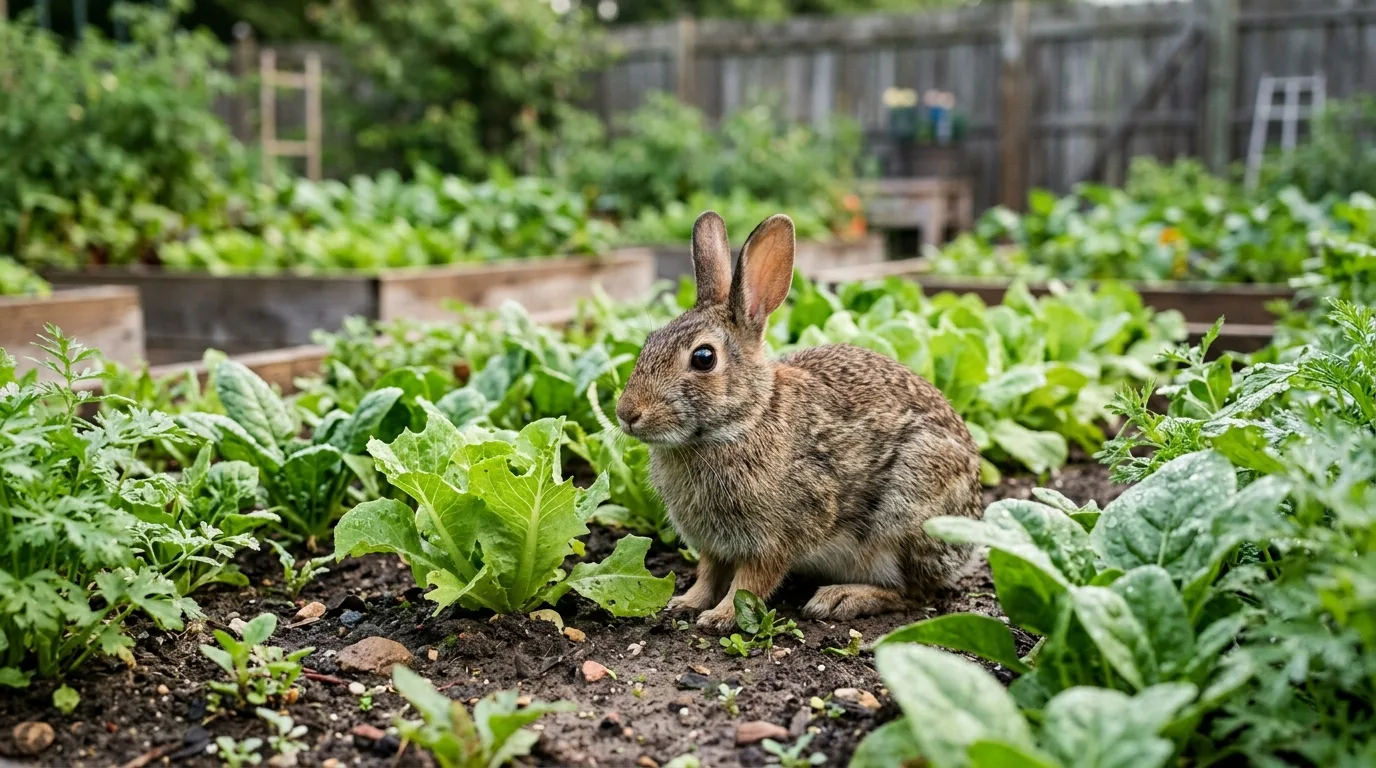
The bean row was knee-high on Tuesday. By Thursday afternoon it's a line of bare stubs, each stem cut off so cleanly it looks like someone walked the bed with a pair of pruners. The peas next to it got the same treatment. And here's the part that throws people: it didn't happen in the dark. You were out there at dusk, you were out there at dawn, and whatever did this came and went in broad daylight while you weren't looking.
That single detail—daylight—is your biggest clue, and most gardeners waste it. The nighttime raiders are a different cast entirely. The animals that strip a vegetable bed in daylight are a short, well-behaved list: rabbits and tree squirrels just about everywhere there are gardens, plus a regional supporting cast of groundhogs, chipmunks, and ground squirrels across North America. Each one leaves a signature. The cut, the height it happens at, the tracks and droppings and burrow holes left behind, and—crucially—when the damage shows up will tell you which one you've got, usually before you ever see the animal.
So before you buy a single repellent or string a foot of fence, read the scene. This guide walks you through the tells, then through the exclusion that actually holds.
The fork in the road: a clean cut or a ragged tear?
If you learn one thing from this article, make it this. It's the fastest way to cut your suspect list in half, and it works because of teeth.
Rabbits and rodents carry chisel-like incisors on both the top and bottom jaw. They bite straight through a stem, and the result is unmistakable: a clean, diagonal cut at roughly 45 degrees. University of Maryland Extension describes the damage as "45° clean angular cuts that almost look like someone went into your garden with pruners". UC IPM puts the mechanism plainly—rabbits "use their incisors to make a characteristic diagonal, 45° cut when clipping off woody twigs, buds from saplings, or flower heads".
Deer can't do that. They have no upper front teeth at all, so they grasp a shoot and twist and pull, tearing it loose. UC IPM spells out the contrast: deer "have no upper front teeth and must twist and pull when browsing, leaving a ragged break on the branch. Rabbits clip twigs off cleanly, as if with a knife". Missouri Extension says the same the other direction—plants "clipped off by white-tailed deer have more jagged edges," while cottontails "bite off young plants or small twigs cleanly at a 45-degree angle". The Internet Center for Wildlife Damage Management even runs a side-by-side photo captioned "Damage by a deer (left) and rabbit (right). Note the clean, 45° angle of the damage by the rabbit".
That one observation does a lot of work. Deer is the contrast case here—the rest of this guide is about the daylight crowd—but knowing the cut means you can rule the deer out without ever seeing it.
A clean, knife-angled cut is a rabbit or a rodent; a ragged, torn break is a deer.
The height of the damage is a fingerprint
An animal can only reach so far, and that ceiling is one of the most reliable tells you've got.
Rabbits work low. UC IPM notes that "most rabbit damage is close to the ground," with deer damage distinguishable in part because it occurs "above a height that rabbits can reach—about 2 feet". Maryland Extension pins cottontail browsing to "less than three feet above the ground". The UK figures line up almost exactly in metric: the Royal Horticultural Society says foliage gets grazed "up to a height of 50 cm (20 in) by rabbits standing up on their hind legs", and Forest Research, the UK forestry research agency, puts browsing and bark-stripping damage "up to a height [of] 540 mm in normal conditions, higher over lying snow". Across two hemispheres, that's the same story: a clean cut more than about two feet up is probably not a rabbit.
Snow rewrites the rule. Rabbits stand on the snowpack and reach bark and buds they couldn't otherwise, clipping young plants "up to 2 inches above the height of the snow," as ICWDM puts it—which is why winter bark damage can show up surprisingly high on a young trunk.
One regional refinement worth knowing if you garden where European hares live alongside rabbits: UK government guidance separates the two lagomorphs by height, with "rabbit damage … typically below 50cm on the tree" and "hare damage … typically below 70cm". Rabbits also "tend to browse outward from cover," while hares "often browse along a row of trees"—a pattern tell when the height alone is ambiguous.
The timing tell: why daylight is the whole point
Here's the distinction that separates this article from the one about your garden getting wrecked overnight. The animals below are out when you are.
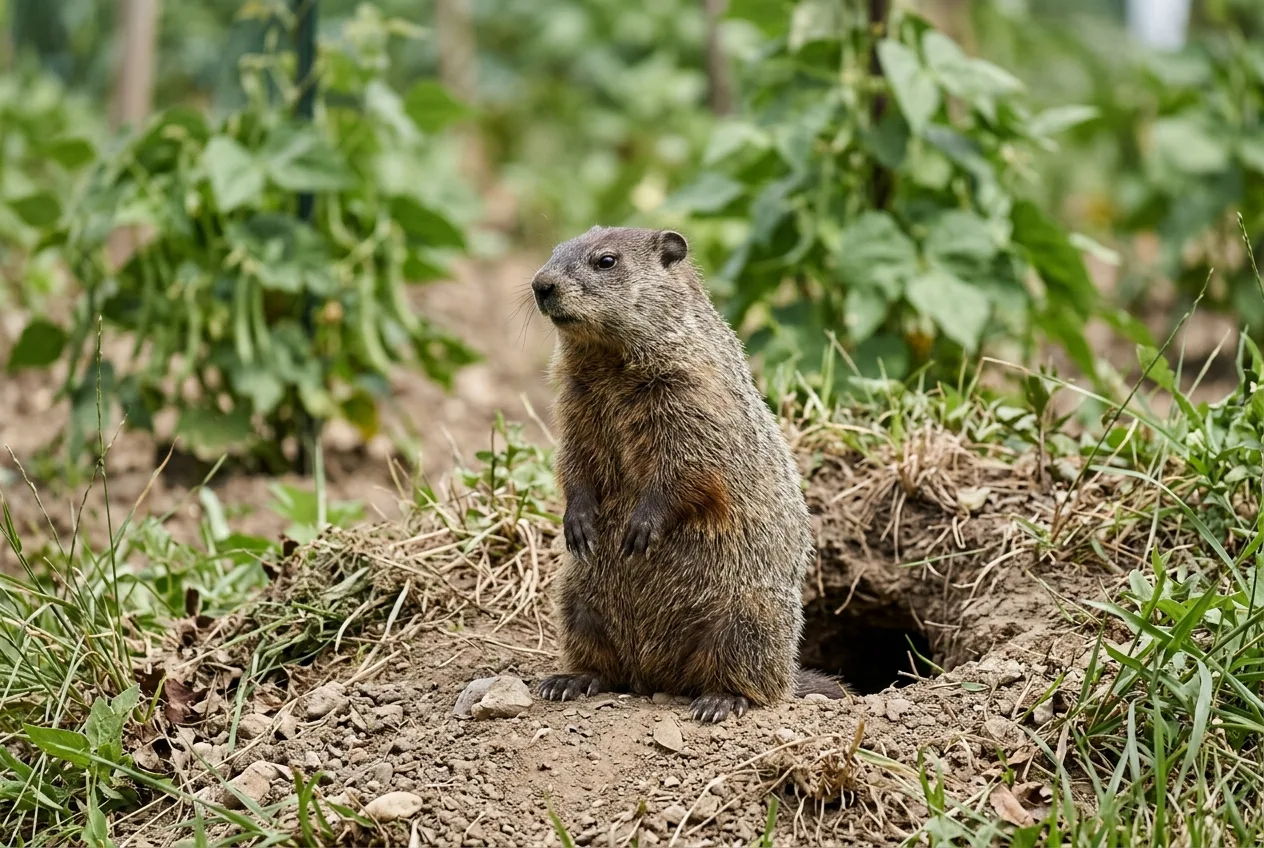
Groundhogs are the clearest case. Rutgers describes them as "heavy-bodied diurnal animals"; Missouri Extension says they're "most active during early morning and late afternoon"; the Government of Alberta notes they're "active during the day, and when not feeding, can often be found sunning themselves on fences, walls, rocks or logs". Missouri makes the point that lands the hook—a woodchuck is "one of the few species of large, wild mammals commonly observed during the day". If a fat brown animal is mowing your beans at two in the afternoon, you don't have a mystery.
Tree squirrels are flat-out daytime animals: "active during the day … most active in early morning and late afternoon," per UC IPM. Ground squirrels are out "mainly from midmorning through late afternoon, especially on warm, sunny days". Chipmunks are "most active during the early morning and late afternoon". None of these is a night-shift animal, so dawn-and-dusk damage that you keep blaming on "something nocturnal" is very often one of them.
Rabbits are the one asterisk, and it's worth being precise. Cottontails lean crepuscular—Maryland Extension calls them "crepuscular, which means you are most likely to see them in your garden at dawn and dusk when they are most active", and UC IPM says feeding "usually begins during the evening hours and continues throughout the night into the early morning". But they don't vanish at sunrise. Missouri Extension notes cottontails are "active during the day, so they can be easily observed during their daily activities", and the RHS says rabbits "do most of their feeding between dusk and dawn but can also be active during the day". So: dawn and dusk are prime rabbit hours, daytime sightings are normal, and a true 3 a.m.-only raider is more likely something from the nocturnal list. What's Eating My Garden at Night? How to Identify the Culprit by Its Damage
A woodchuck is one of the few large wild mammals you'll routinely watch feeding in broad daylight.
Tracks, scat, and the calling cards
When the cut and the height leave you with two suspects, the sign breaks the tie.
Droppings are the most honest witness in the garden, and rabbit pellets are distinctive. The Wildlife Trusts describe them as "clusters of little, round, hard balls … usually yellowy-brown or green in colour, and full of grass". Maryland Extension offers the homelier version: rabbit scat is "usually round and can resemble a Cocoa Puff cereal … hard, dark brown, and filled with undigested fibrous materials". UC IPM adds a size cue—jackrabbit pellets run "up to 1/2 inch in diameter, whereas pellets of the cottontail are closer to 1/4 inch". Find a scatter of little round balls near clipped stems and you've all but confirmed rabbits.
Tracks help when the soil is soft. Maryland gives cottontail dimensions: front paws about "1 ⅜ inches long," hind prints "2 1/16 inches long," and they're "often left in pairs".
Tooth-mark width is a quieter clue that separates rabbits from the smaller rodents. Penn State notes a rabbit's tooth marks average about "0.08 inch" wide, and Wisconsin measures rabbit incisors at "2.7mm (upper) and 2.8mm (lower)"—noticeably broader than the fine grooves a vole or mouse leaves. If the gnaw marks on a gnawed trunk look tiny and messy rather than broad and clean, you're probably not looking at a rabbit.
A scatter of little round, grass-filled pellets near a clipped stem is about as close to a signed confession as a garden gets.
Reading the burrow: groundhog vs. chipmunk vs. ground squirrel
If something is digging as well as eating, the hole itself often names the animal. The three diurnal burrowers leave very different front doors.
| Burrower | Entrance size | Dirt mound? | Other tells |
|---|---|---|---|
| Groundhog (woodchuck) | 10–12 in (25–30 cm) | Yes—conspicuous mound of fresh dirt | Burrow runs 25–30 ft (~8–9 m) long, up to ~5 ft (1.5 m) deep, with two or more entrances |
| Ground squirrel | ~4 in (10 cm) | Sometimes | Lives in colonies; active burrows show fresh digging, inactive ones have "cobwebs across the entrance" |
| Chipmunk | ~2 in (5 cm) | No—and that's the tell | "Not surrounded by obvious mounds of dirt, because the chipmunk carries the dirt in its cheek pouches" |
The groundhog hole is the big one—Missouri and Alberta both put the main entrance at 10 to 12 inches (25–30 cm) across with "a large mound of excavated earth" beside it. A chipmunk's roughly 2-inch hole with no mound is the opposite signature: the absence of dirt is the clue. And a ground squirrel's burrow sits in between at about 4 inches (10 cm), with a useful active-vs-abandoned check—a working burrow shows recent digging, while an "inactive burrow will be filled with leaves or old straw, or have cobwebs across the entrance".
What gets eaten helps too. Groundhogs go for "various beans, cole crops (broccoli, cabbage, cauliflower etc.), carrot tops, clover, squash and peas,". An adult eats "up to 1.5 lbs of vegetation per day," so damage tends to be wholesale—plants mowed down rather than nibbled—and it stays close to home, because woodchucks foraging from a den in a soybean field "may forage only 20-30 yards from their home dens". Chipmunks and ground squirrels are seed-and-seedling specialists: chipmunks "eat flower bulbs, seeds, or seedlings", and ground squirrels hit "vegetables in the seedling stage". If your transplants vanish the week they go in but the established plants are fine, think small rodent, not groundhog.
The bulb-and-bark crowd: tree squirrels
Tree squirrels damage a garden differently from everything else here, and the giveaways are bulbs, bark, and freshly dug holes in the lawn.
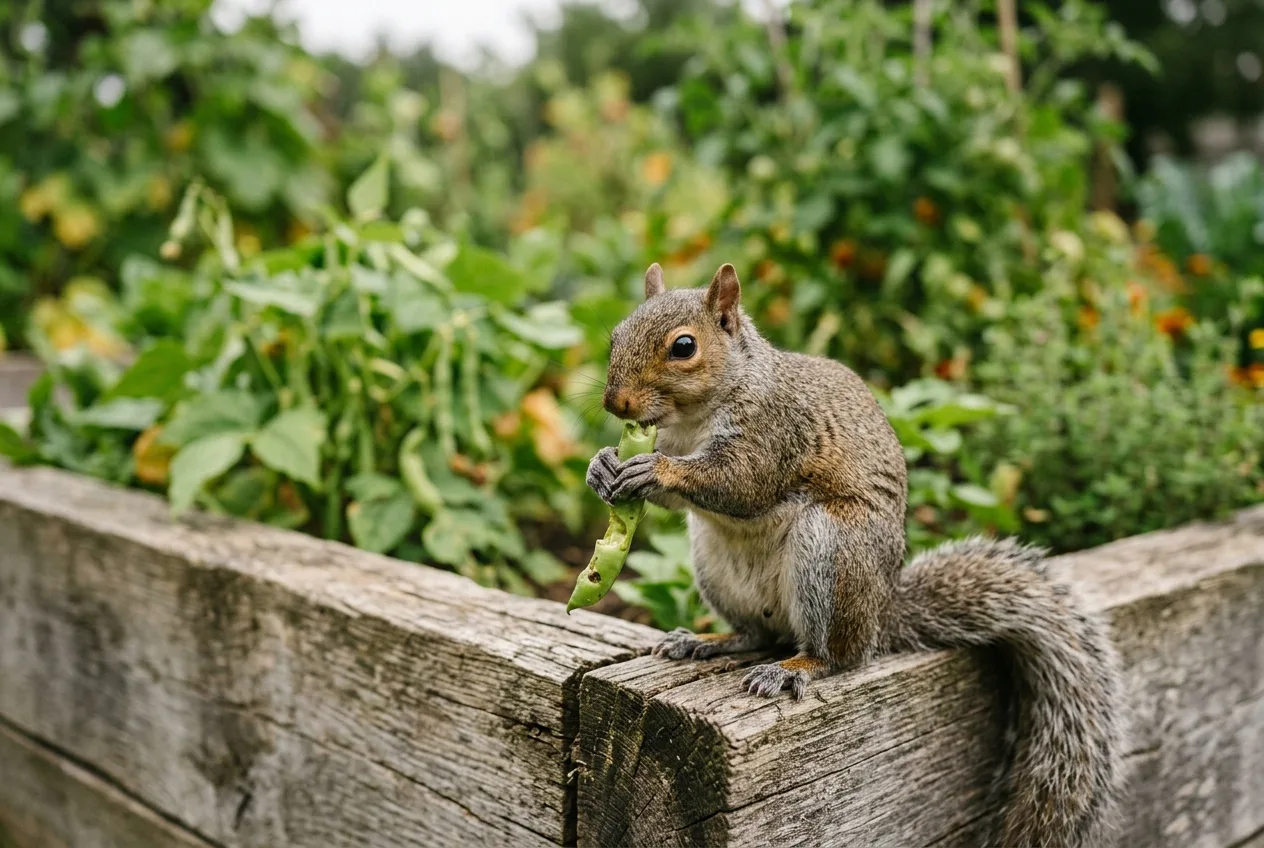
They're omnivores with a sweet tooth for your crops. UC IPM lists "immature and mature almonds, English and black walnuts, oranges, avocados, apples, apricots," plus "strawberries, tomatoes, corn" when foraging on the ground. In the UK the introduced grey squirrel goes after "tulip bulbs, crocus corms, sweetcorn, strawberries, apples, pears, nuts, sunflower seed heads and flower buds of camellias and magnolias". Two signatures stand out. First, digging: squirrels "dig holes in garden soil or in turf where they bury nuts, acorns, or other seeds," mostly in the fall, and they'll dig up and eat bulbs and corms you just planted. Second, bark stripping: they "strip bark to feed on the juicy inner bark layer (cambium), causing injury to trees". The grey squirrel does enough of it that the RHS warns trees like "sycamore, maples, ash and beech, can be badly damaged or even killed by bark stripping", and the Woodland Trust confirms greys "affect the composition of native woodland by bark stripping".
One honest note on bark stripping, because it shapes whether you can do anything about it: the RHS observes that most of it "appears to be associated with stress brought on by territorial disputes," more likely "when squirrel numbers are high". That's not behavior you can repel away—which is the recurring theme of the next section.
Bulbs dug up, bark peeled off young limbs, and holes punched in the lawn point to squirrels, not rabbits.
What actually keeps them out (and what doesn't)
Here's the blunt truth the extension literature keeps repeating: a good fence is the only thing that holds, and repellents in a vegetable bed mostly don't. Let's take exclusion first, because it's where your effort pays off.
Rabbit fencing — the specs that matter
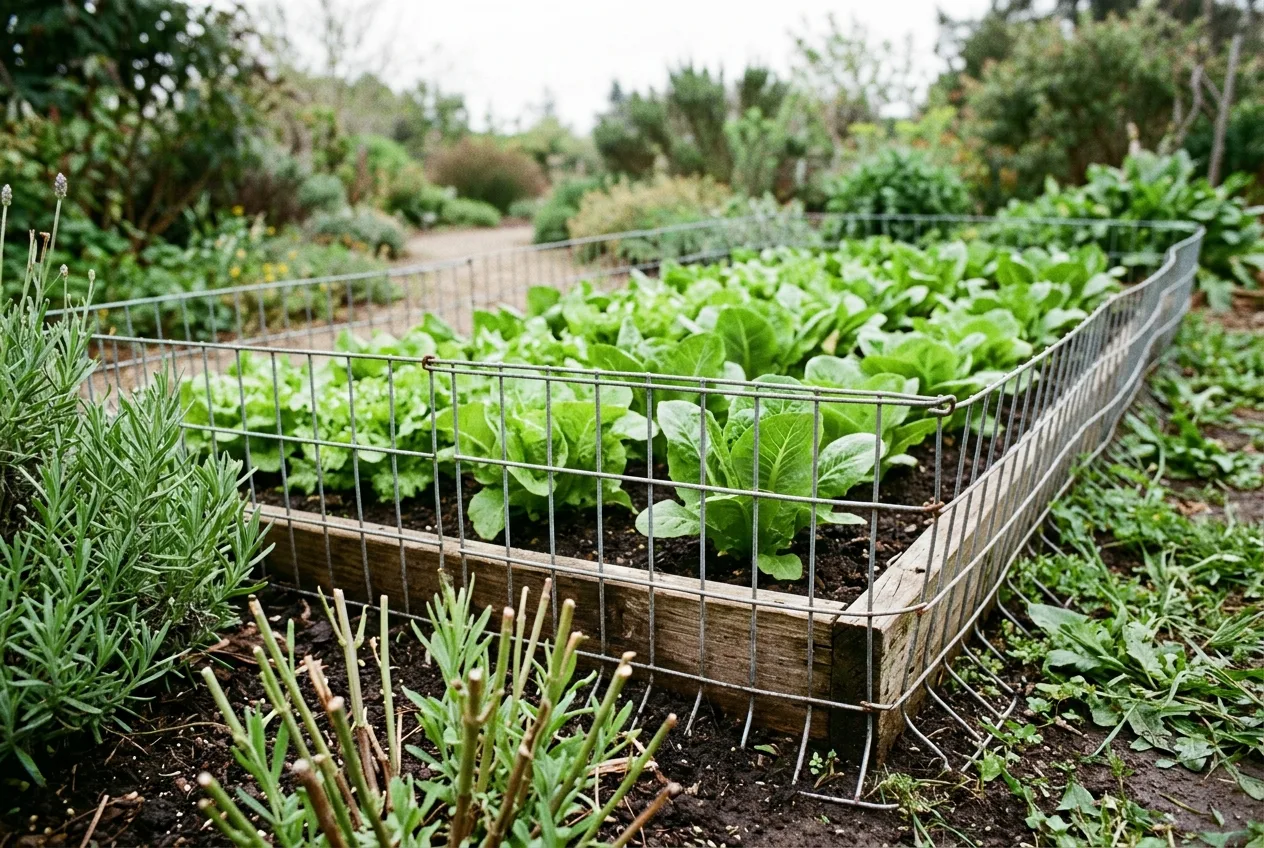
The non-negotiables are mesh size, height, and burying the bottom. Get those right and a fence works for years; get the mesh wrong and young rabbits walk through it.
- Mesh: small enough to stop a baby rabbit. UC IPM is explicit: "the mesh size should be no larger than 1 inch in order to exclude young rabbits". The UK and Australasian specs agree closely—the RHS calls for "2.5 cm (1-1¼ in) wire mesh", New Zealand's Marlborough District Council says "2.5–3cm", and Australia's PestSmart says "40 mm or less". Use wire, not plastic; rabbits chew through plastic netting.
- Height: this is where sources diverge by species, so match it to your rabbit. UC IPM notes "cottontails and brush rabbits won't jump a 2-foot fence," so two feet of above-ground height is enough for them, while jackrabbits warrant raising it to three feet. Penn State likewise calls a "2-foot, chicken-wire fence" adequate for cottontails. European rabbits, which are stronger jumpers, get taller fences: the RHS specifies "120–140 cm (48–54 in)", and PestSmart notes "rabbits can jump over 500 mm fences," so at least 900 mm. The simple rule: two to three feet stops a cottontail; go to roughly four feet (120–140 cm) for European rabbits or jackrabbits.
- Bury the bottom: rabbits dig. UC IPM says to "bury the bottom at least 6 to 10 inches into the ground," and—the detail people skip—bend "a few inches of the fence bottom outwardly" to defeat digging. The RHS version: sink "the bottom 30 cm (1ft)" with "the lower 15 cm (6in) bent outwards". Forest Research specifies a "150 mm" out-turn at the base, buried or covered.
For a small bed or a few prized plants, you can skip the trench. The RHS notes individual plants can be ringed with "netting 90 cm (3 ft) high, without the need to lay part of the fence in the ground", and Marlborough suggests "a small circle of netting, 80cm high" around a single plant.
Groundhog fencing — taller, and remember they climb
A groundhog fence has to beat an animal that both digs and climbs—"woodchucks are excellent climbers and can easily crawl over fences," Missouri warns. The fix is height plus an unstable or out-turned top, plus the same buried L-footer:
- Height and top: three to four feet (about 0.9–1.2 m), with the top defeated. The Humane World for Animals (formerly the Humane Society of the United States) describes a fence that should "reach 3 to 4 feet above ground level" and either "wobble as the groundhog tries to climb it" or have "the top 10 to 15 inches outward at a 45-degree angle" (25–38 cm). UConn and Rutgers say the same—top 12 inches (30 cm) "bent outward," or "unattached to the fence posts" so it can't be scaled.
- Buried base: UConn says "bury the lower edge 10 to 12 inches deep" (25–30 cm); Rutgers and Alberta describe burying about a foot (25–30 cm) with the bottom bent horizontally outward into an L.
- Mesh and electric: welded or chicken wire "with mesh size no bigger than 3 by 3 inches" (about 7.5 cm) works; a single electrified strand about 4 inches (10 cm) off the ground adds insurance.
A humane note that matters with groundhogs specifically: if you're closing up an active burrow, time it so you don't trap dependent young underground. The Humane World guidance is to evict and exclude "from mid- to late summer or between early July and late September in most areas," after the young are mobile but before hibernation.
Trunk guards, bulb cages, and small rodents
For young tree trunks against rabbits, wrap a cylinder of wire. UC IPM describes "poultry netting with a 1-inch mesh … formed into cylinders" (about 2.5 cm), buried 2 to 3 inches (5–7.5 cm) and braced an inch or two (a few cm) off the trunk so the rabbit can't press through it; Wisconsin and Penn State prefer "¼ inch" (about 6 mm) hardware cloth, standing "an inch or two out from the tree trunk" and extending above expected snow depth. Forest Research rates "0.6 m high mesh guards or shelters" for European rabbits, with a caution that spiral guards "must be wound between branches," because a rabbit can gnaw bark "through a [loose] spiral". Partly gnawed trunks, the RHS adds, can be "wrapped in black polythene" to help the wound callus over.
For chipmunks and the bulb-diggers, the move is to cap the planting with hardware cloth. ICWDM and Penn State both say to cover seeds and bulbs with "¼-inch hardware cloth" (about 6 mm), itself "covered with soil," extending "at least a foot past each margin of the planting" (30 cm). The RHS offers an elegant version for bulbs: drop them into "a planting basket designed for aquatic plants" and cover the top "with chicken wire" before sinking it. For tree squirrels on an isolated trunk or pole, a "2-foot wide collar of metal 6 feet off the ground" (about 0.6 m wide, 1.8 m up) stops climbing—though on a tree surrounded by other trees, squirrels simply jump across, and exclusion becomes a losing game.
Repellents: manage your expectations
This is the part where the sources are unusually candid, so I'll be too. In a vegetable garden, repellents are a weak tool, for three concrete reasons.
First, most can't legally go on the part you eat. UC IPM: most repellents, "except for some of the taste repellents, can't be used on plants or plant parts that humans eat," and "repellents usually fail when you use them in a vegetable garden". Missouri agrees they're "unsuitable for use on garden crops meant for human consumption". Second, animals get used to them. Rabbits "can build a tolerance to repellents, eventually making them less effective"; for grey squirrels, repellents and scaring devices "are likely to give no more than short-term protection". For ground squirrels it's bleaker still—UC IPM states there are "no effective squirrel-frightening devices or repellents that will cause ground squirrels to leave their burrows or avoid an area or crop". Third, they wash off and don't protect new growth, so you're reapplying after every rain and every fresh leaf.
If you do reach for one on ornamentals, the products with the best support are fear-based: UC IPM points to repellents containing "dried blood (e.g. Plantskydd) or putrescent whole-egg solids (e.g. Bobbex)" for rabbits. But treat repellents as a stopgap on non-edibles, not a strategy for the bean row. As Penn State puts it, fencing is what provides "long-term, nonlethal control".
A cheaper habit that genuinely helps: take away the cover. Rabbits hide in "brambles, piles of brush, stones, or other debris"; chipmunks and groundhogs travel under tall vegetation, so keeping grass short around bed edges and buildings—and moving bird feeders "15 to 30 feet from buildings"—makes the whole area less inviting.
In a vegetable bed, a buried, small-mesh fence is the only thing that lasts; everything else just buys time.
Confirm the culprit before you commit
One thread runs through every source above, and it's a warning against assuming. PestSmart says it cleanly: when you assess suspected rabbit damage, "it is important to remember that other animals such as grasshoppers, hares and wallabies might cause similar damage". The damage signature builds your shortlist; it doesn't always convict. A 45-degree cut is a rabbit or a rodent. A dug bulb could be a squirrel or a chipmunk. A mowed-down bean patch near a big burrow is almost certainly a groundhog—but "almost" is doing work in that sentence.
The honest way to close the gap is to watch the bed. The catch is that you can't stand in the garden all afternoon, and your presence changes the animal's behavior. This is the rare case where the daytime habits of these raiders actually help you: a camera aimed at the wrecked row will catch a diurnal feeder in good light, doing the deed, no flashlight or 2 a.m. vigil required.
Read the damage to build your shortlist, then let the camera settle which suspect on the list actually showed up. With the right name, you can match the fence to the animal—2.5 cm mesh and a buried lip for a rabbit, a tall wobble-top for a climbing groundhog—instead of building the wrong barrier twice.
A quick field cheat-sheet
- Clean 45° cut, under ~2–3 ft (≤50–90 cm), round pellets nearby → rabbit
- Ragged, torn break (the contrast case—not a daytime raider) → deer
- Plants mowed down near a 10–12-inch (25–30 cm) burrow with a dirt mound → groundhog
- Bulbs dug up, bark stripped off young limbs, holes punched in the lawn → tree/grey squirrel
- Seedlings and bulbs gone near a tidy ~2-inch (5 cm) hole with no mound → chipmunk
- Seedlings clipped near a ~4-inch (10 cm) burrow, fresh digging at the entrance → ground squirrel
Frequently asked questions
How do I know if it's a rabbit or a deer eating my plants?
Look at the cut and the height. Rabbits slice stems cleanly at a 45-degree angle, "as if with a knife," and stay low—usually under about two feet; deer have no upper front teeth, so they tear a ragged, jagged break, and their damage runs higher up the plant. Round, grass-filled pellets confirm rabbits.
What's eating my vegetables during the day rather than at night?
The daytime crowd is short: groundhogs, tree squirrels, ground squirrels, and chipmunks are all diurnal, and rabbits—though they peak at dawn and dusk—are commonly active by day too. If the damage appears while the sun's up, you can rule out the strictly nocturnal raiders like raccoons.
How can I tell a groundhog burrow from a chipmunk or ground squirrel hole?
By the size of the hole and whether there's a dirt mound. A groundhog's main entrance is a big 10-to-12-inch (25–30 cm) hole with a conspicuous mound of excavated dirt; a chipmunk's is a tidy ~2-inch hole with no mound at all; a ground squirrel's is about 4 inches.
What mesh size and height stops rabbits?
Use wire mesh no larger than 1 inch (about 2.5 cm) so young rabbits can't slip through, at least 2 feet tall for cottontails and roughly 4 feet (120–140 cm) for European rabbits or jackrabbits, with the bottom buried 6–10 inches and bent outward to stop digging.
Do repellents actually work on rabbits and squirrels in a vegetable garden?
Not reliably. Most repellents can't legally be used on the parts of food crops you eat, animals build a tolerance to them, and they wash off in rain—"repellents usually fail when you use them in a vegetable garden". For ground squirrels there are "no effective" repellents at all; fencing is what lasts.
Why are squirrels stripping the bark off my young tree?
Tree and grey squirrels gnaw bark to reach the nutritious inner cambium layer, which can girdle and kill young limbs. Much of it is linked to territorial stress and tends to spike when squirrel numbers are high, so it's hard to repel away—physical guards on the trunk are the dependable fix.