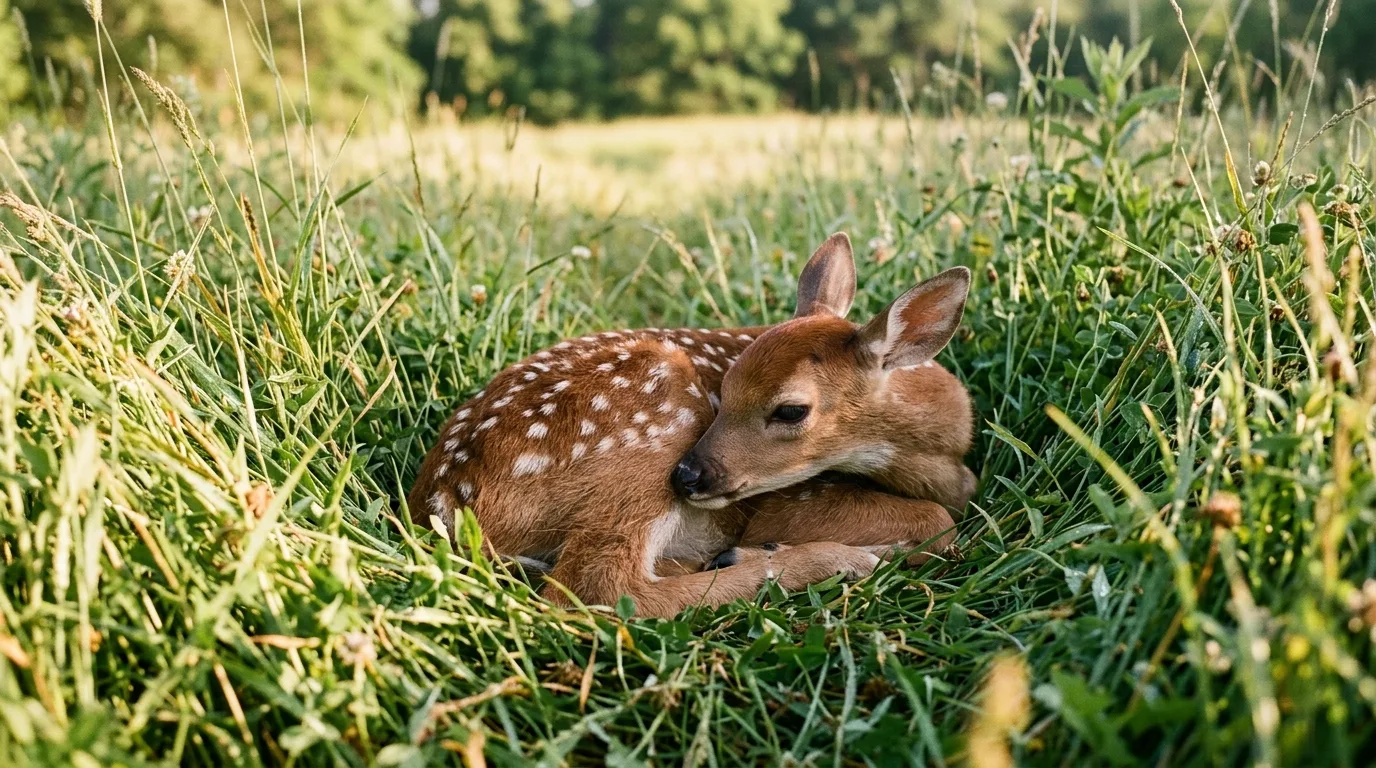
If you want the short answer, here it is: across most of North America, white-tailed deer give birth in late May and June, after a pregnancy of roughly 200 days. In Virginia, the peak "fawn drop" lands on about the first week of June. In Connecticut, it's late May into early June. New Jersey biologists put the bulk of births in "the last week of May and the first two weeks of June". If you find a spotted fawn curled in tall grass in early summer, you're seeing the system working exactly as designed.
But "late May and June" is the headline, not the whole story. Push south and that window slides later — South Texas fawns aren't on the ground until mid-to-late July. Push the timing question one step further and you get to something more interesting: deer don't pick June by accident, and they don't drift around the calendar the way the weather does. The date a fawn is born was effectively set seven months earlier, by the length of the day, and it was set to put that fawn into the world at the one moment its mother can actually feed it. Once you see that, a lot of deer behavior — the rut, the hiding, the twins, the brutal first month — starts to make sense as one connected thing.
So let's earn the rest of the answer.
The 200-day clock: from the rut to the fawn drop
Work backward from a June fawn and you land in November. That's not a coincidence; it's arithmetic. The average gestation period for a white-tailed doe is about 200 days, with most sources putting it in the 200–210 day range — Montana State Extension and the old Arkansas reproductive study both cite roughly 202 days. Texas Parks and Wildlife used "an average of 200 days from conception" to back-calculate fawning dates across the whole state. So the math is simple and it's the same math biologists use: take the peak of the fawn drop, count back 200 days, and you've found the peak of the rut.
Virginia's deer project leader spells it out plainly. "If we call the peak of the fawn drop June 3, that puts the peak of conception at November 16," he writes — which is why his advice to hunters is to be in the stand the weeks around November 16 "every year, no matter what the thermometer or moon chart says". The Penn State Deer-Forest Study runs the same clock the other way: "Fifty percent of females are bred by 13 November. That means about half of all fawns are born by May 31st".
Here's the part worth internalizing. The trigger for all of this is photoperiod — day length — and nothing else moves it much. As deer move into fall, shortening days drive the hormonal cascade that brings does into estrus. A doe is only in heat for roughly 24 to 48 hours at a time; if she isn't bred, she recycles about every 28 days and tries again. The rut you see is just the cumulative effect of a lot of does hitting that 24-hour window at once. And because day length on a given date is "pretty darn consistent" from year to year, the breeding date is too.
What does not move the date: the moon, the temperature, the first cold snap. "Multiple studies utilizing GPS collars, from Mississippi to Pennsylvania, have demonstrated that moon phase has no meaningful impact on deer behavior". Mississippi State's Deer Lab is blunter still: weather has "absolutely no influence on the timing of breeding behavior". Cold weather makes deer move more, so hunters see more, which is where the "the cold kicked off the rut" folklore comes from — but the doe's internal clock doesn't read a thermometer. (How rut timing actually drives a hunting season is its own rabbit hole — The Moose Rut: When It Peaks, How Bulls Behave, and the Calls You'll Hear.)
One honest caveat the sources insist on: this is a bell curve, not a switch. Does are bred on different days, and pregnancies vary a little in length, so fawning dates spread out around the peak. Most fawns hit the ground near the average date, with a few stragglers at the tails. "Some fawns might be born in April or August, but most of them will be born around the first part of June in Virginia". Pennsylvania's Game Commission has documented a fawn conceived as late as March 3 — which wouldn't be born until late September. So if a reader in your area swears they saw a tiny spotted fawn in October, they probably did. It's improbable, not impossible.
The rut you see is just the cumulative effect of a lot of does hitting that 24-hour window at once.
When fawns are born, region by region
The single biggest thing that shifts fawning dates is latitude, and the reason is forage. A fawn has to be born when green-up can fuel its mother's milk and give it a summer to grow before winter — so the "ideal" birth date moves with the climate. Northern deer face a hard, short window and birth on a tight schedule; southern deer have mild winters and a long buffet, so their births smear across a much wider season.
Texas is the clearest illustration, because the gradient plays out inside one state. Texas Parks and Wildlife examined 2,436 does across 16 study areas and mapped breeding (and therefore fawning) by ecological region:
| Texas region | Peak breeding | 90% of fawns born by |
|---|---|---|
| Gulf Prairies & Marshes (north) | Sept 30 | May 10 |
| Pineywoods (south) | Nov 12 | June 19 |
| Edwards Plateau (west) | Dec 5 | July 13 |
| South Texas Plains (west) | Dec 24 | July 25 |
That's a two-and-a-half-month spread in fawning dates within a single state — the earliest deer in the Gulf Prairies are dropping fawns before the latest South Texas does have even bred. The old Arkansas study found the same pattern in miniature: does in the northern part of the state conceived around November 13, roughly three weeks earlier than central and southern Arkansas, producing a mean fawning date of June 3 in the north versus June 25 in the south. As the Arkansas authors put it, citing earlier work, the genus Odocoileus "generally breeds earlier in northern latitudes".
For most readers in the whitetail's core range — the Midwest, Northeast, and Mid-Atlantic — late May through June is the reliable answer. In central Iowa, a fawn-survival study captured newborns at a mean date of May 27. In the Northern Great Plains, neonates were on the ground across Minnesota and the Dakotas through that same late-spring window. The pattern holds: the colder the winter, the tighter and earlier the birth pulse.
A quick note for the western half of the country: mule deer run on a similar clock. Their peak mating is November–December, gestation is "about 7 months," and they typically drop a single fawn the first year and twins thereafter. Utah's wildlife agency simply tells the public to expect mule deer fawns and elk calves "in June".
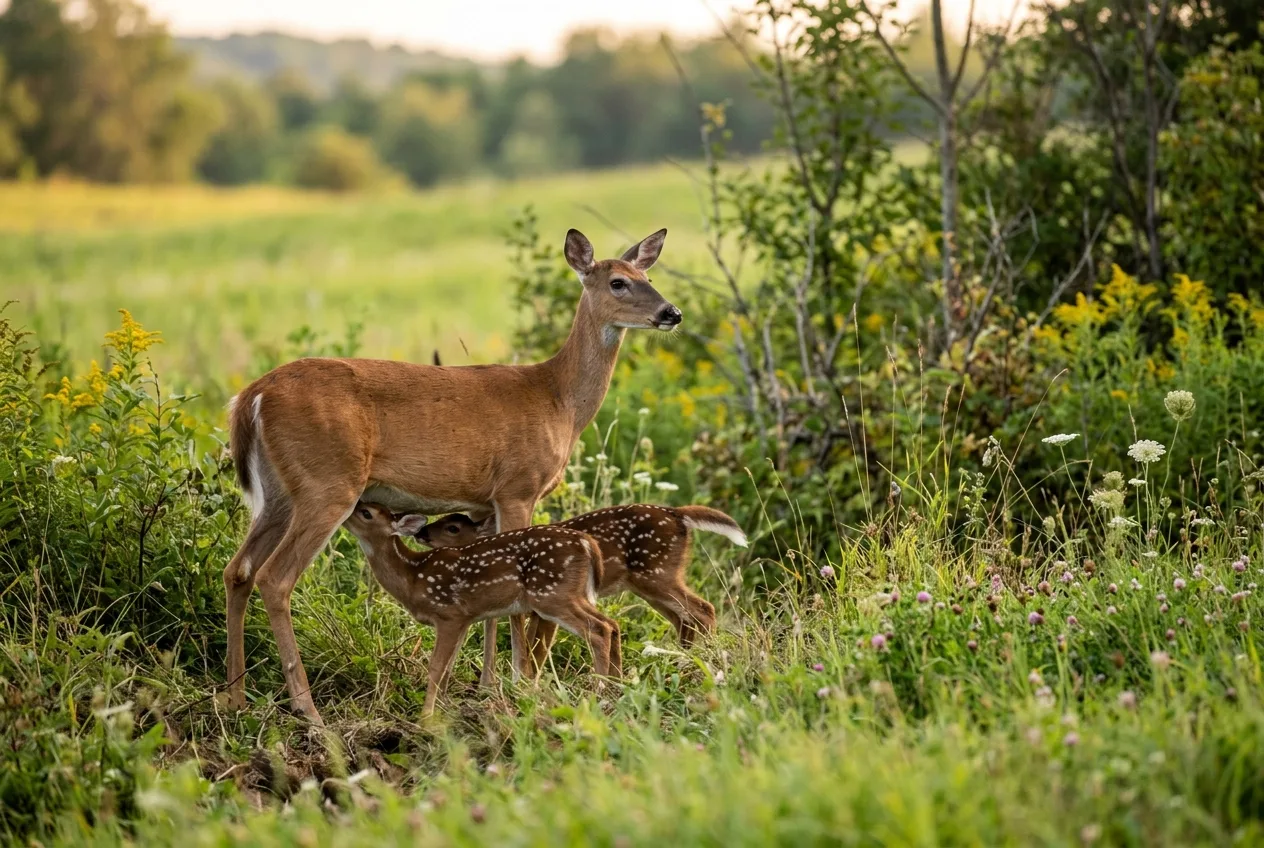
Why births are synchronized — the "they-can't-get-all-of-us" strategy
Notice what's happening in the North: it's not just that fawns are born in spring, it's that they're born in a clump. In Pennsylvania, nearly 70% of all does are bred during November. That tight birth pulse isn't an accident either, and the leading explanation is grimly elegant.
The Penn State Deer-Forest Study lays out the two competing ideas. The first is predator swamping: if every fawn arrives at once, you flood the market. "It's a they-can't-get-all-of-us mentality," as their write-up puts it. "If all young are born at the same time… it's like an all you can eat buffet. Predator bellies are too full. They can't eat all of them". The alternative, predator avoidance, would predict the opposite — births spread out so a coyote has a harder time finding any single hidden fawn.
So which is it? A study pooling more than 860 fawns across nine areas (Pennsylvania included) came down on the side of swamping: "Patterns of fawn survival better support the predator swamping hypothesis, not predator avoidance; and predators may present a selective force great enough to shift reproductive synchrony". In other words, on top of food and temperature, predation may itself help set when does give birth.
I'd flag one wrinkle the same write-up is honest about, because it matters for how you read the data. Fawns born after the peak — but not before it — were at higher predation risk. If swamping were the whole story, you'd expect both tails to suffer. The likely explanation isn't really about coyotes at all: late fawns tend to be the offspring of young, first-time, or poorly conditioned does, so they're already underweight and disadvantaged before a predator ever shows up. Heavier fawns had measurably lower predation risk in their first 30 days. Sometimes "the bear got it" hides the fact that the fawn "was going to die no matter what". It's a good reminder that birth timing, body condition, and survival are tangled together, not independent dials.
Birth timing, body condition, and survival are tangled together, not independent dials.
The newborn fawn: built to disappear
For its first two to three weeks, a fawn's whole survival strategy is to not be found. Whitetails are hiders, not followers — the doe stashes the fawn in cover and leaves. A newborn spends most of the day bedded down, lying dead still, relying on a spotted coat for camouflage and on producing almost no scent. The mother returns only a few times a day to nurse, then leaves again specifically so her own scent and movement don't draw a predator to the spot. A doe "seldom strays more than 100 yards from its fawn", but she is deliberately, strategically absent.
The fawn does its part. Bedded and alarmed, it will drop its heart rate by over 30% — a freeze response that keeps it still and silent while a predator passes. (Worth correcting a common myth here: fawns are not truly odorless. As one Texas A&M wildlife specialist puts it, "their odor helps mom find them when they get separated" — they're just very low-scent, and the doe actively manages the rest by consuming the afterbirth and the fawn's waste.) If a doe has twins, she'll often bed them apart "to improve the chances of at least one surviving".
Now for the part that genuinely surprised researchers — and that should make anyone cautious about simple "more cover is always better" advice. In a fire-maintained Mississippi study, fawns that **moved more and bedded in less dense cover survived better against coyotes**. Survivors averaged 268.8 meters of movement per day in their first 10 days; coyote-killed fawns averaged just 138.2. Fawns that picked the densest bedsites were the more likely to be eaten. The authors' interpretation is striking: the ancestral hider strategy "could be maladaptive in novel contexts" — that is, against coyotes, a relatively new predator in the eastern U.S., sitting still in thick cover may be the wrong move. A companion analysis found only "weak support for bedsite cover" as a driver of survival, concluding that mitigating coyote predation "may be more complicated than simply managing for increased hiding cover". File that away for the management section — it complicates the standard playbook.
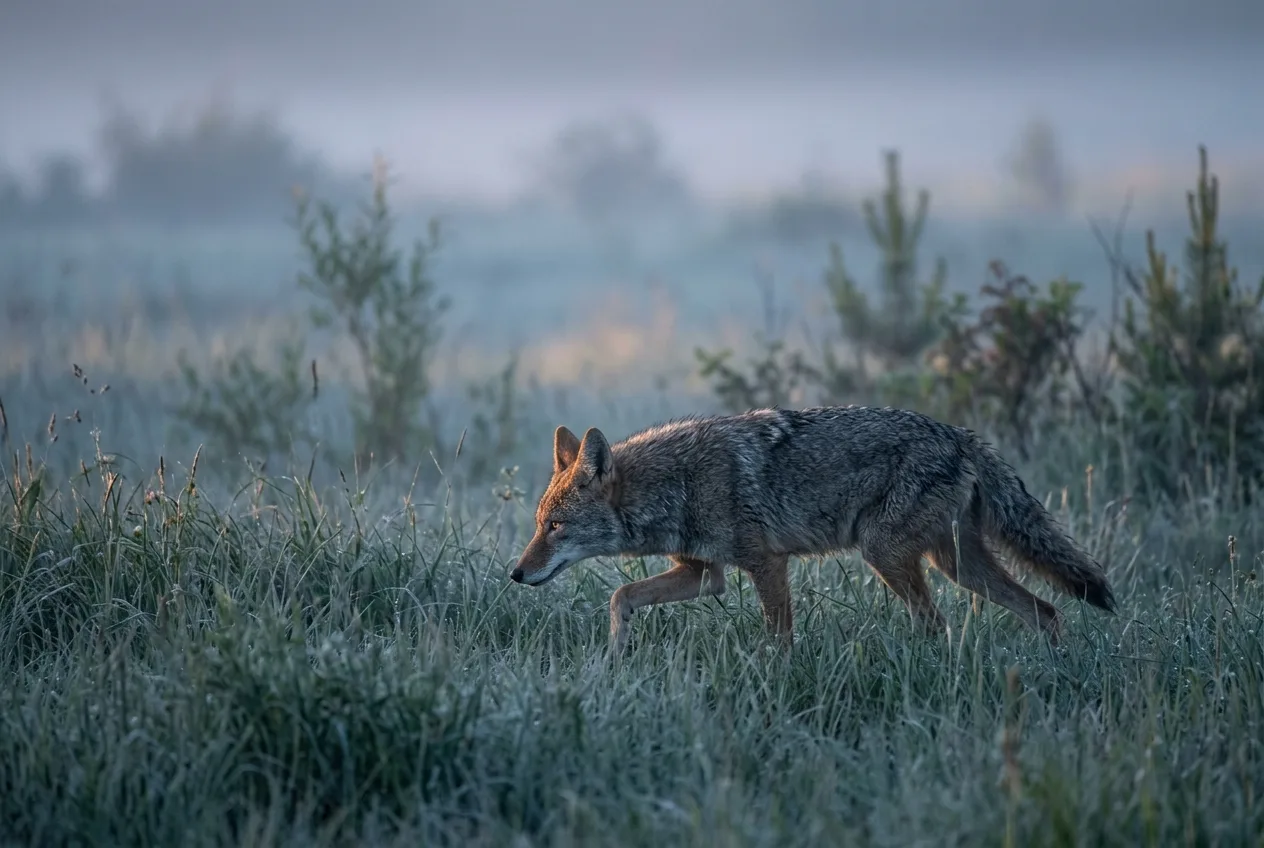
Why the timing matters: survival, predation, and management
Here's the stakes behind all this biology: that first month is the deadliest stretch of a deer's life, and how many fawns make it is what drives whether a herd grows or shrinks.
The numbers vary enormously by region, and the variation is the point. In the Southern Appalachians of north Georgia, researchers radio-collared 71 fawns and watched cumulative 12-week survival come in at 0.157 — meaning roughly six of every seven fawns died — with predation causing 45 of 55 mortalities (82%), mostly coyotes, black bears, and bobcats. A Mississippi study saw 16-week survival of just 0.141, coyotes responsible for the bulk of it. Compare that to the Northern Great Plains, where one-month survival ran about 82%, or central Iowa, where 30-day survival was 0.78 — and where the leading killer wasn't a predator at all but disease, specifically an EHD outbreak that hit older fawns. Same species, wildly different odds, depending on what's on the landscape.
Two threads from the research are worth pulling for anyone managing land:
- Predation is usually the top threat, and cover is a lever — but a nuanced one. The National Deer Association points to work by Will Gulsby and colleagues showing that "fawns with the least amount of 'edge' in their home ranges were more than 2 times as likely to be eaten by a coyote than fawns with greater edge availability". Old fields, meadows, and thick early-successional growth near food and water make good fawning habitat. But remember the Mississippi finding: the densest bedsite isn't automatically the safest one. The goal is a diverse, broken-up landscape that gives fawns room to move and escape, not just a wall of brush. Terrain matters too — an Alberta study found fawns that used steeper ground survived coyote predation better, and that a green, productive spring (high NDVI) lifted survival across the board.
- Birth timing itself is a management variable. A classic Texas study of penned, known-age does found that younger mothers fawn later and over a longer, sloppier window: three-year-old-and-older does had a mean fawning date of June 19, two-year-olds July 8, and yearlings all the way out to August 3. The management implication is one heavy-handed antlerless harvest can trigger: lean too hard on the older does and you shift the herd's age structure younger, which pushes fawning later, spreads it out, and — because late fawns have less time to grow before winter — tends to mean fewer fawns that survive. It's a real argument for harvesting with the herd's age structure in mind, not just its headcount.
Fawn recruitment is the number that tells you whether your management is working.
Twins, triplets, and what a doe's body is telling you
Litter size is one of the cleaner signals of herd health, because it tracks nutrition almost directly. The default for a healthy adult whitetail doe is twins; triplets aren't rare on good range. Texas found that statewide, over half of examined does carried twins, with triplets in under 2%. Yearling does, breeding for the first time, "usually give birth to one fawn," while older does "will usually breed twins and sometimes triplets".
A captive study put precise weights on all of this. Across 229 fawns from 119 litters — 16 singletons, 96 sets of twins, and 7 sets of triplets — the mean litter size was 1.8 fawns per mother. And the per-fawn cost of sharing a womb shows up in birth mass: singletons averaged 3.2 kg, twins 2.6 kg, and triplets just 2.2 kg. Whitetail fawns generally weigh about 6 to 8 pounds at birth and can double that in their first two weeks. That early weight is not trivial — the same study found fawn birth mass was a good predictor of adult body size, and recall that heavier fawns survive predation better in that first month. The chain runs: a well-fed doe builds a heavier fawn, which survives better and grows into a heavier adult. Thin does, late fawns, and singletons-where-you'd-expect-twins are all early warnings that the range is carrying more deer than it can feed.
Thin does, late fawns, and singletons-where-you'd-expect-twins are all early warnings that the range is carrying more deer than it can feed.
If you find a fawn: leave it alone
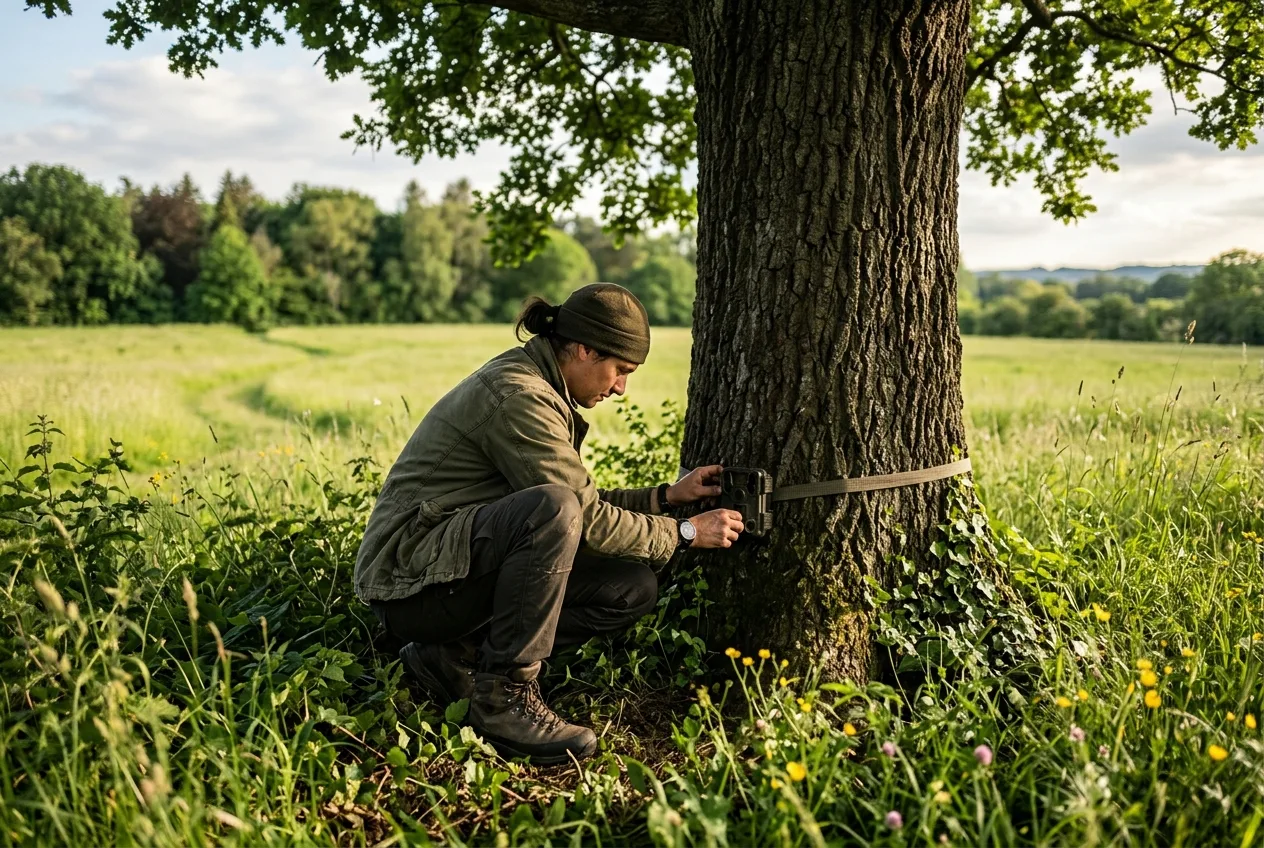
This is the part that reaches well past hunters, and it bears repeating every single June, because the mistake is so easy to make with the best intentions. You walk up on a fawn lying alone in the grass, no mother in sight, perfectly still. It looks abandoned. It is almost certainly not.
"A fawn's best chance of survival is with its mother," Wisconsin's DNR says flatly. That long stretch of apparent solitude is the plan: "Young fawns are often left alone for most of the day to keep them safe," and because deer are most active at dawn and dusk, the doe can be away for hours at a stretch. Utah's wildlife agency says the same — newborn fawns "are actually frequently alone and isolated during their first weeks of life, and that's on purpose. The mother knows that leaving the fawn alone is the best way to protect it from predators". The mother is watching, usually within 100 yards, waiting for you to leave so she can come back.
The data on "rescuing" fawns is stark. Texas Parks and Wildlife found that in some years, 40% or more of fawns brought to rehabilitators were never orphaned or injured at all — they were healthy fawns scooped up by well-meaning people. And rehab is no substitute for a mother: in a Connecticut study, 86% of rehabilitated fawns were dead within 100 days of release, with coyotes the leading cause. The blunt conclusion: "human intervention does not increase fawn survival, but likely decreases it". Touching a fawn can leave your scent on it — which draws predators — and getting close enough to spook it burns energy it can't spare.
So, the rule, straight from the agencies:
- Don't touch it, don't feed it, and don't move it. Improper feeding alone can cause "nutritional deficiencies that can lead to deformities or death". And it's not a myth-buster excuse — a doe will not reject a fawn because a human touched it; the danger is the scent you leave for predators, not the mother's reaction.
- Leave the area, and keep kids and pets well away. The mother won't return while people or dogs are around.
- Know the real signs of trouble. Step in only for a fawn that's wandering and crying for hours, is visibly injured, looks lethargic or emaciated, has sat in the exact same spot for more than ten hours, or is near an obviously dead doe. In those cases, call a licensed wildlife rehabilitator or your state game agency rather than handling it yourself.
One more reason to keep your hands off, beyond the fawn's welfare: by the Fourth of July, most fawns are up and moving with their mothers anyway. The kindest and smartest thing you can do is back away and let the system you just read about do its work.
Frequently asked questions
When do deer give birth?
Most white-tailed deer give birth in late May and June across the core of their range, after a pregnancy of about 200 days. Timing shifts later as you move south — South Texas fawns aren't typically born until mid-to-late July.
How long are deer pregnant?
A white-tailed doe's gestation is roughly 200 days, with sources citing a range of about 200–210 days (commonly ~202). Mule deer are similar at "about 7 months".
How many fawns do deer usually have?
Twins are the norm for a healthy adult doe, and triplets aren't uncommon on good range; yearling does usually have a single fawn. One captive study averaged 1.8 fawns per mother across 119 litters.
Why do deer give birth at the same time each year?
Because breeding is triggered by day length (photoperiod), not weather, and day length on a given date barely changes year to year. Births are timed — and in the North, tightly synchronized — so fawns arrive when forage can fuel the mother's milk, which may also help "swamp" predators with more fawns than they can eat.
I found a fawn alone — is it abandoned?
Almost certainly not. Does deliberately leave fawns hidden and alone for most of the day during their first two to three weeks, returning only to nurse. Don't touch, feed, or move it; leave the area so the mother can return.
What is the survival rate of fawns?
It varies enormously by region. Some Southern studies report only ~14–16% surviving the first 12–16 weeks, mostly to predators, while parts of the Northern Plains see one-month survival around 82%. Predation — chiefly coyotes, with black bears and bobcats — is usually the top cause, though disease can dominate in some years.