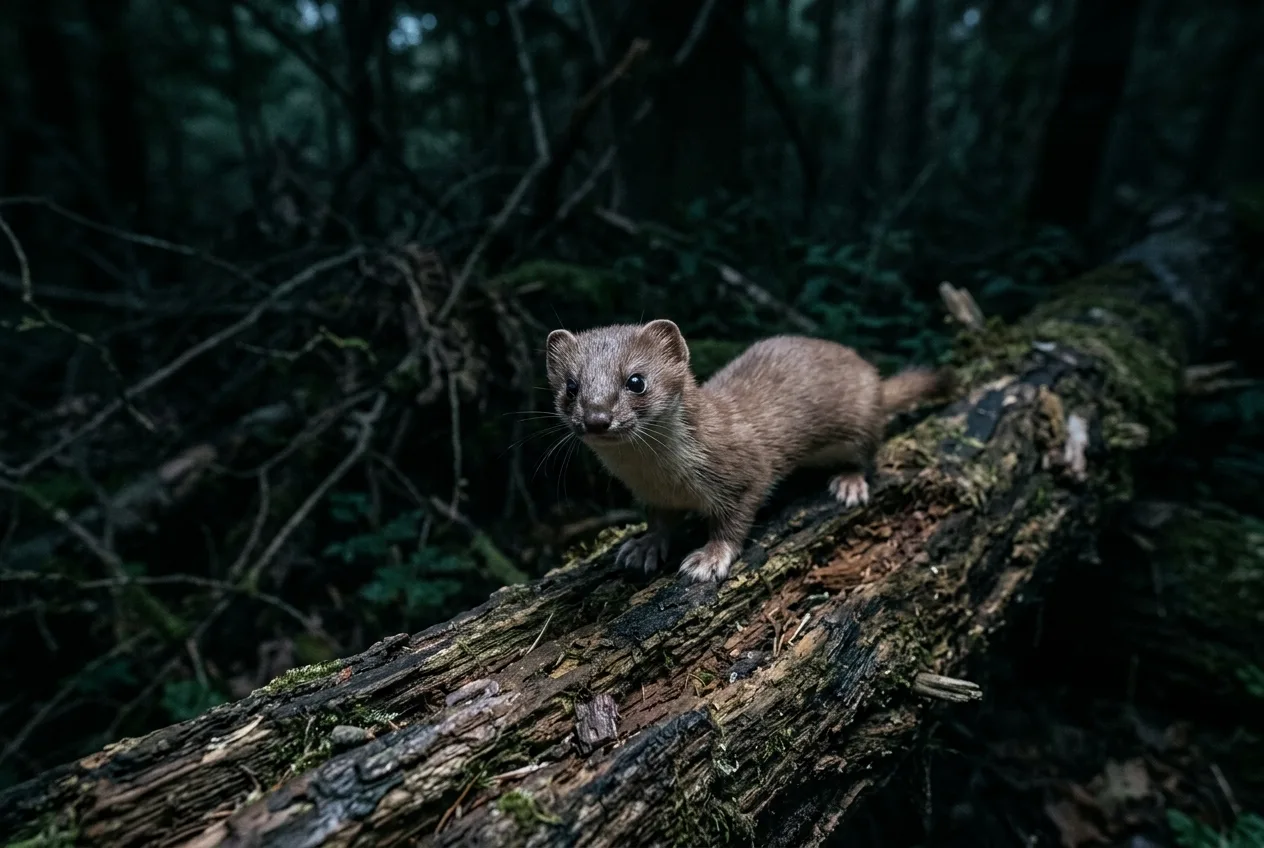
A brown, low-slung shape pours across the frame at 2 a.m. — long body, short legs, gone in three frames. You know the family on sight: it's a mustelid, the weasel tribe. But which one? Weasel or stoat? Mink or marten? On a grainy infrared clip, with no color and a half-second of footage, that's a genuinely hard call — and you're in good company finding it hard.
It might be the hardest family to identify on a camera, full stop. When nearly 4,000 volunteers in a University of Michigan study sorted more than 10,000 camera-trap sequences, they nailed the animals overall 97% of the time. The mustelids wrecked that average. Fewer than 1% of mustelid images were correctly identified by all fifteen reviewers who saw them, and even the consensus guess was right only 59% of the time — far and away the lowest of any group. North America's three weasel species are no easier on standard trail cameras: in one nationwide survey, weasels were photographed 51 times, and 27 of those — more than half — "could not be identified to species".
So this isn't a you problem. It's a real one, and it gets harder in the dark. But it's not hopeless. A handful of features separate these animals reliably, and — crucially — a few of them survive the night, when color drops out and most field marks turn to mush. This guide walks the whole small-mustelid family across the northern hemisphere — weasels, mink, polecat, marten, fisher — feature by feature, and tells you which clues still work on a black-and-white night clip and which ones quietly fall apart.
Start with size, not species
The single most useful move is also the least glamorous: decide how big the animal is before you try to name it.
The Vincent Wildlife Trust — which has spent years running cameras on exactly these species — splits Britain and Ireland's small mustelids into two groups for identification, and it's the right instinct everywhere. Group one is the weasel and the stoat, "head and body less than 30cm." Group two is the pine marten, polecat, polecat-ferret and mink, "head and body 30-50cm". They share a body plan — that long, tubular, short-legged shape that lets them follow prey down a burrow — which is exactly why "because of their similar body shape they can be difficult to distinguish from each other, especially when, as is usually the case, they are seen only briefly and in poor light". The shape tells you the family. Size starts to tell you the member.
The catch on camera is that size is the thing you can least trust from a photo. With nothing in frame for scale, a weasel ten feet away and a marten thirty feet away can look identical. So size-class is a starting hypothesis you confirm with proportion and markings — not a verdict on its own. The rest of this guide is those markings, group by group.
They share a body plan — that long, low, short-legged shape — which is exactly why the family is easy and the species is hard.
The small group: weasel vs. stoat (and which weasel)
Here's the group people mean when they say "weasel." Two animals dominate it across the northern hemisphere — the weasel and the stoat — plus, in North America, a third, the long-tailed weasel. They look almost alike: brown above, pale below, fast and slinky. The differences are small, but they're consistent.
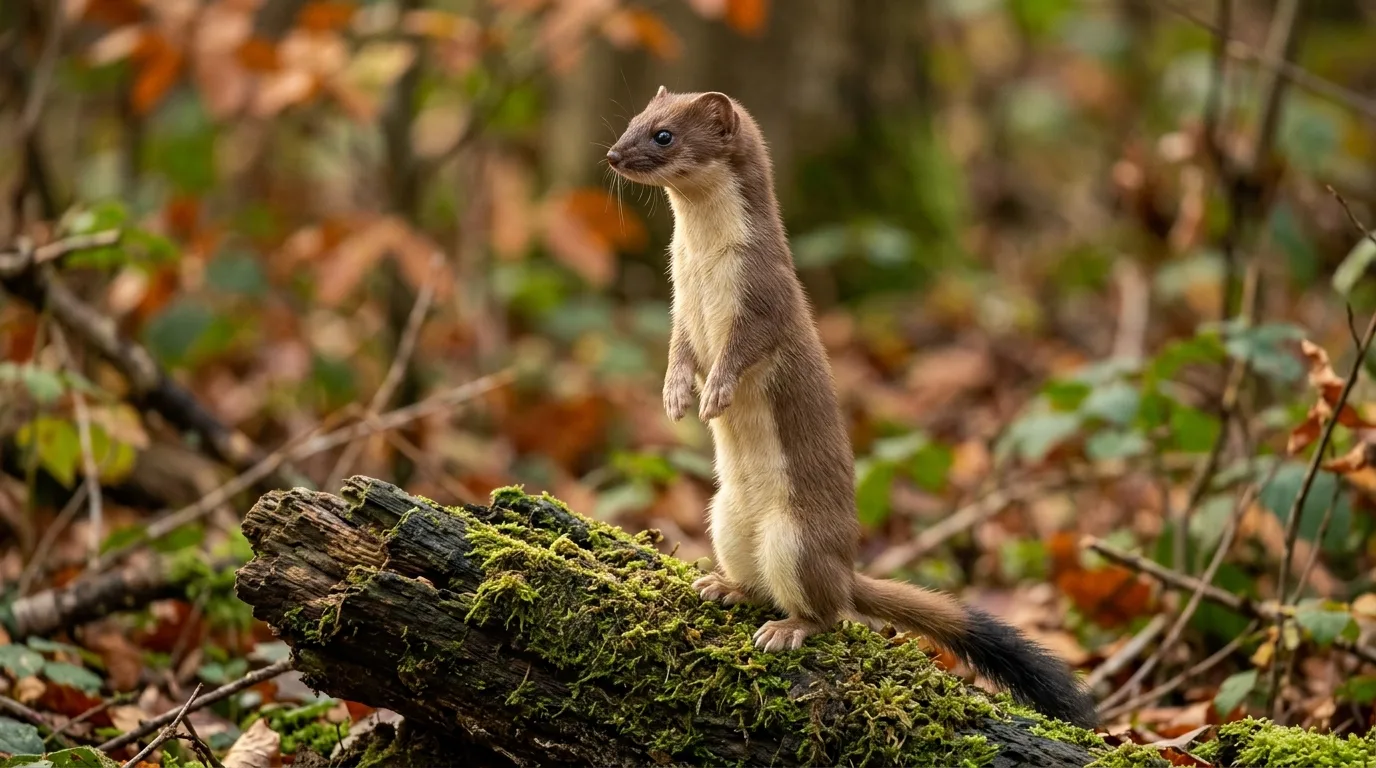
The tail is the whole game. This is the most-repeated rule in the entire literature, and it earns its reputation. A stoat — called the ermine or short-tailed weasel in North America — has a longer tail with a sharp black tip. The European (common) weasel and the least weasel have a short tail that's brown to the end, no black tip. The Woodland Trust puts it plainly: "The easiest and most reliable way to tell a stoat from a weasel is the tail. A stoat's tail is around half the length of its body and ends in a bushy black tip. A weasel's tail is short and stubby by comparison and solely brown in colour". Animal Diversity Web describes the least weasel's tail as "less than a quarter of the head-body length" and "always lacking the black tail tip found in two similar species: ermines… and long-tailed weasels".
Why this clue matters so much for cameras: the black tip is tonal, not colored. Black-versus-brown reads as dark-versus-light even when your photo has no color at all — so unlike the coat's rusty hue, the tip can survive an infrared frame, provided you can actually see the tail.
Size and the colour line back it up. The stoat is the larger of the two. British figures put male stoats at 27.5–31.2 cm head-and-body, females 24.2–29.2 cm, with a 9.5–14.0 cm tail; the weasel runs smaller, males 19.4–21.7 cm and females just 17.3–18.3 cm, with a 3–6 cm tail. The Mammal Society offers the memorable gauge: a "weasel head can fit through a wedding ring, whereas an adult stoat head cannot". Look, too, at the line where the brown back meets the pale belly. On a stoat it's "a straight line separating the two colours"; on a weasel it's "undulating" and "irregular and spotted" — patchy, with flecks of brown intruding into the cream. A weasel often also shows a small brown "gular spot" on each side of the throat that a stoat lacks.
The gait is a live-animal tell. If you catch movement, watch how it runs. The stoat has a "characteristically arched-back bounding movement"; the weasel's gait is "quicker, flatter and less bounding," running close to the ground. As one BBC Wildlife guide puts it, "Stoats are bouncier than weasels when they're running; a running weasel tends to be quicker and lower to the ground". On video, that bounce is sometimes clearer than any single body part.
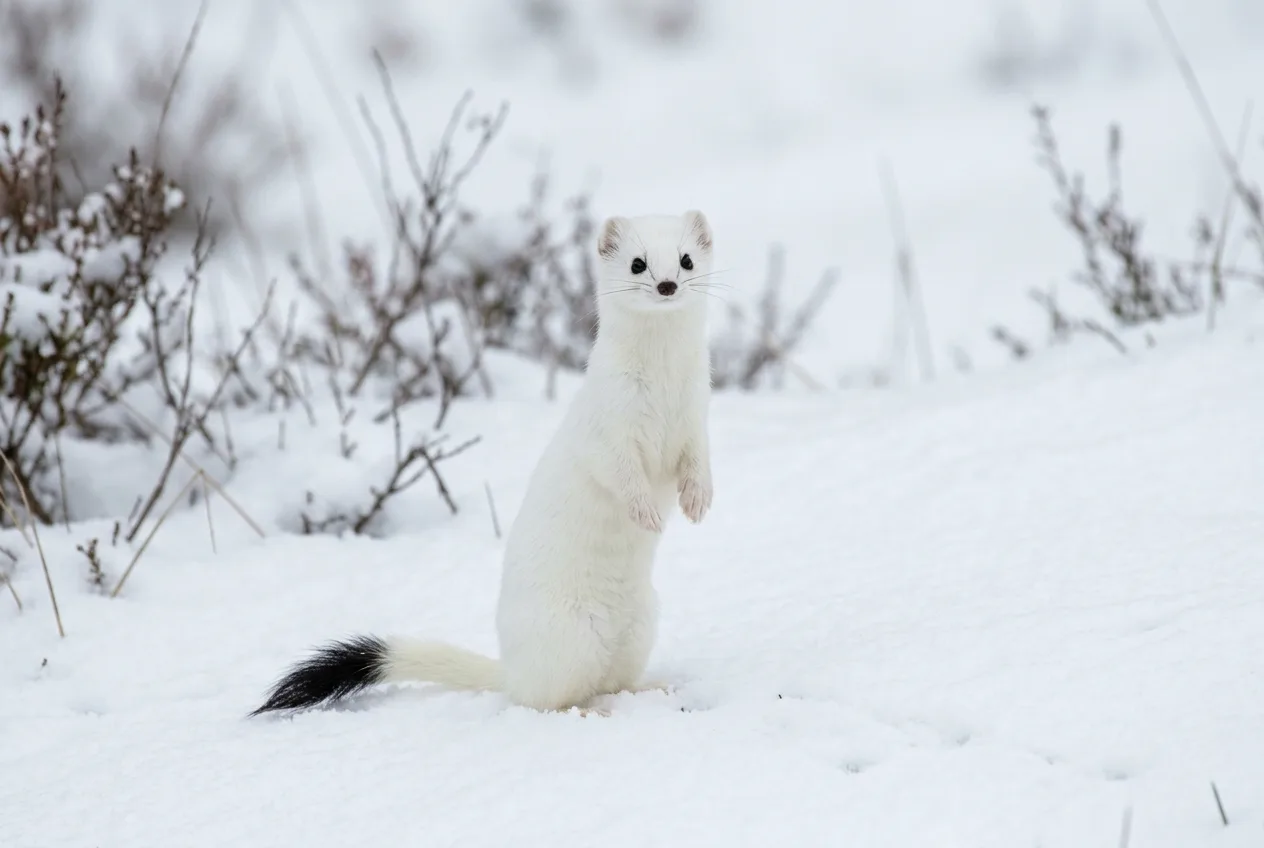
The white winter coat — but only where winters are snowy. This is where you have to be careful, because it's latitude-dependent, not calendar-dependent. In colder, snowier parts of their range, stoats moult into a white winter coat — the famous "ermine" — keeping only that black tail tip. In Britain that happens in Scotland and northern England; in Ireland and southern England the winter coat "stays brown," and in between you get piebald, mottled animals. In Pennsylvania, "most ermines change from brown to white for winter," while only "five of every six" long-tailed weasels stay brown. The trigger isn't temperature but day length — the moult is "triggered not by temperature but by amount of light per day". So "white = winter" is only true where the winters are white; don't assume it for a mild-climate camera. And that black tail tip is the thing that saves you when an ermine is otherwise a white blur — it's "always present, even in white winter coat", and it's thought to draw the strike of predators like hawks and owls away from the body.
The third weasel: long-tailed (North America only). Where ranges overlap in North America, a third species joins the puzzle. The long-tailed weasel is the largest of the three — 15 to 23.5 inches including a 3.2–6.3-inch tail — and it, too, carries a black tail tip. Telling it from the ermine is genuinely hard; Wisconsin's wildlife agency admits "tail length is the only good way to distinguish between the two, but it can be challenging to tell in the wild". The NPS offers the proportion to watch: the long-tailed weasel's tail is "nearly equal the length of its body, while the… ermine's end-hugger is closer to half the length of its body". And the least weasel anchors the bottom end as "the smallest carnivorous predator in the world," averaging about 190 mm total length and as little as 30 grams — brown tail, no black tip, the size of a large mouse with attitude.
Here's a table for the small group. Treat the figures as ranges across regional populations, and remember the night caveat — several of these clues need color or a clear, still view that an IR clip may not give you.
| Feature | Weasel (European / least) | Stoat / ermine | Long-tailed weasel (N. Am.) |
|---|---|---|---|
| Head-body size | Smallest; ~17–24 cm (least weasel ~19 cm total) | Larger; ~24–32 cm | Largest; 15–23.5 in incl. tail |
| Tail | Short, stubby, brown to the tip | Longer, black tip | Long, black tip |
| Belly line | Patchy, irregular, wavy | Straight, sharp | Straight-ish, like ermine |
| Winter white? | European weasel never; least weasel often, in the north | Often, in snowy regions; tip stays black | Only in the north; most stay brown farther south |
| Gait | Flat, fast, low to ground | Bounding, arched back | Like ermine |
On a stoat the black tip stays through every coat, summer brown or winter white — it is the one mark the season can't erase.
The bigger group: bib, mask, or near water
Step up a size class and the cues change. These animals — pine/American marten, the European polecat, American mink, and the fisher — are "much larger and heavier than stoats," with the same long body but more bulk, and they're "more strictly nocturnal, making it difficult to see and identify live animals with certainty". Which is to say: this is the group you'll most often be squinting at on a night clip. Three questions sort almost all of them.
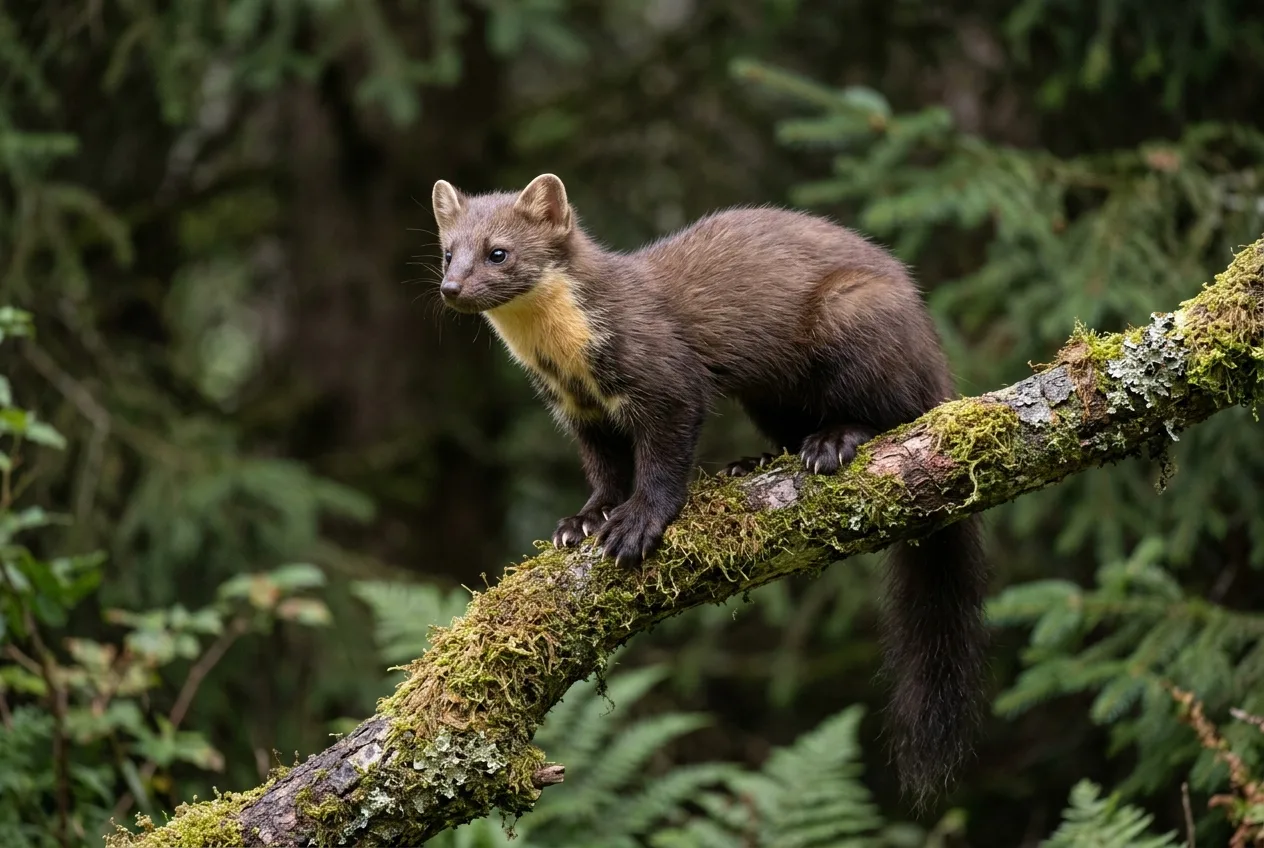
Is there a creamy-yellow bib? → marten. The pine marten (Europe) and American marten (North America) wear a diagnostic patch of creamy-yellow to orange fur across the throat and chest. The Vincent Wildlife Trust is unequivocal: "The large, creamy yellow throat patch is diagnostic". PTES describes the pine marten as cat-sized with "dense, lustrous chocolate-brown fur and a distinctive creamy-yellow patch on their chest and throat" and large rounded ears. In North America it's the same animal in spirit — Maine's marten is "about the size of a house cat… with long, dense brown fur, darker legs, a bushy tail, and a pale, almost white face", and New York notes "a light colored throat patch" on a body with "paler head and underparts and darker legs". In Canada the winter coat shows "a bright orange throat patch". The marten is also the most likely of this group to be up a tree — it's an agile climber that can "leap up to four metres between tree branches," with ankles that "rotate through 180°".
That bib is so individual it doubles as a fingerprint. The Vincent Wildlife Trust found that "every pine marten's bib is unique — much like human fingerprints," which is why researchers use it to tell individual martens apart. The catch on camera: that only works if you can see the bib clearly, which is why camera-trappers who want to recognize individual martens prefer video mode to capture bib patterns.
Is there a bandit mask? → polecat (Europe). The European polecat is the marten's dark-faced cousin and the animal most often confused with a mink. Its coat is "black and tan" — blackish guard hairs over creamy-yellow underfur — and its face carries a distinctive mask: "pale muzzle, ear tips and 'eyebrows,' with a broad dark band around the eyes". The Wildlife Trusts calls it a "distinct bandit-like appearance, with white stripes across its dark face". That pale facial pattern is the whole point, because it's what separates the polecat from the American mink, "which is uniformly dark." One precise tell from the Vincent Wildlife Trust: "The dark fur on the face of a polecat always extends to the nose". Polecats run 32–45 cm with a 12–19 cm tail — right in mink territory, which is exactly why the face matters.
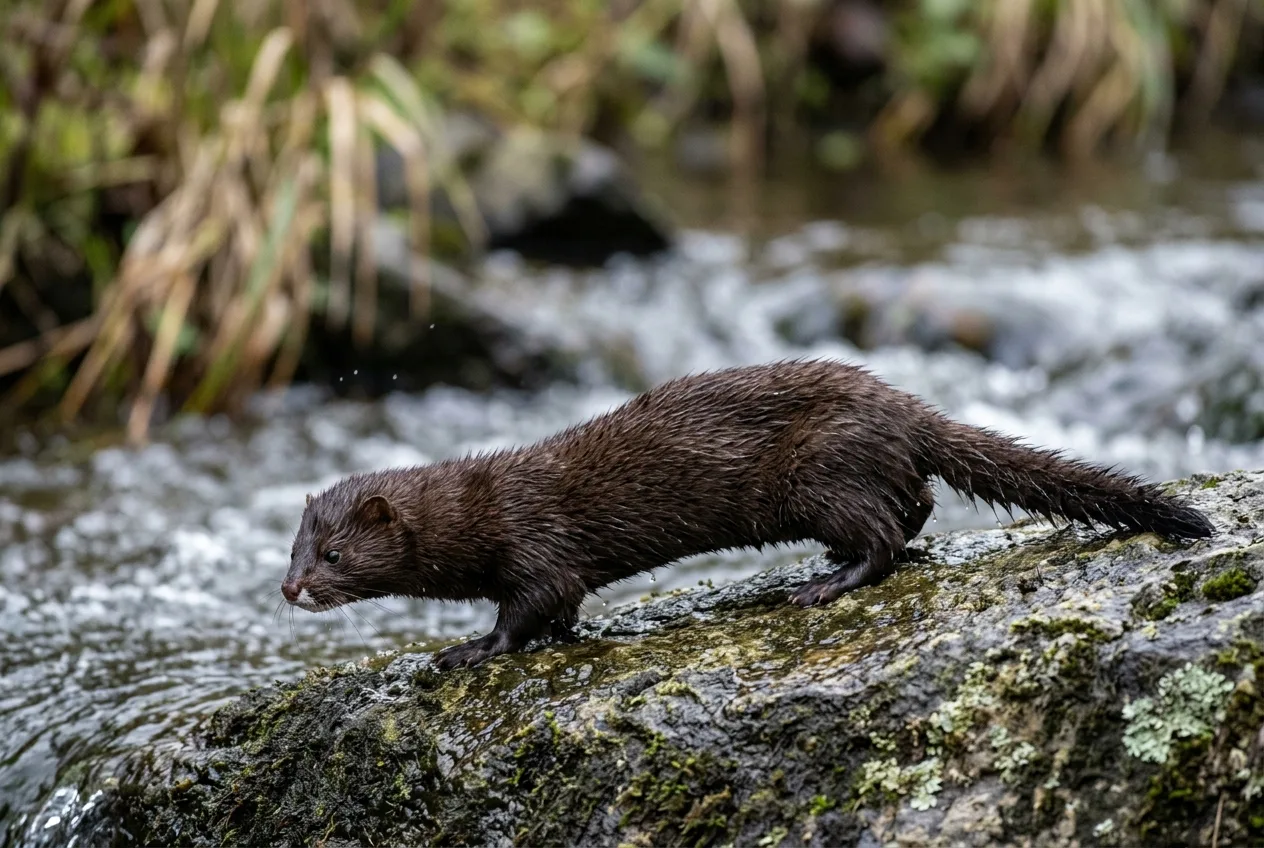
Dark all over, near water, white chin at most? → mink. The American mink (the one established across both North America and, as an invasive, much of Europe) is the plain one: "a uniform dark chocolate brown which may appear almost black," usually with no more than "a white chin patch," and "sometimes white patches… on the chest, belly and groin". Its tail is "slightly bushy and approximately half the body length". The giveaway is where it lives and how it moves: mink are semi-aquatic, "usually found near water," and on camera they "often skirt along the edges of waterways". If your dark mustelid is working a stream bank or a river crossing, mink should be your first guess; if it's a dark animal in dry woodland with a masked face, think polecat. (Europe also has a genuine native European mink, now critically endangered and largely confined to pockets of France, Spain and eastern Europe; its tell is white on both the upper and lower lip, where the American mink usually has white only on the chin.)
A fox-sized version of the lot? → fisher (North America). The fisher is the heavyweight of this family and a North-American-only animal. It has "long bodies with short legs, rounded ears, and a thick dark brown coat with a bushy tail," plus "five toes with retractable claws" that make it a strong climber. It's much bigger than a marten: New York gives male fishers 35–47 inches and 7–15 pounds, females 30–37 inches and 3–7 pounds, "dark brown to nearly black," with older males showing "a gray or grizzled appearance" and some animals a white or cream chest blaze. The clean separation from the marten is size and color: martens are "much smaller," with "a much lighter brown coloration, grayer head". The fisher is also famous as "the only known North American mammal that regularly preys on porcupines" — and, like the marten, it can rotate its hind feet for a headfirst descent down a trunk.
Here's the bigger-group cheat sheet. As above, treat sizes as regional ranges, and note that the bib's and mask's colors are daytime tells — at night you're reading their shape and contrast, not their hue.
| Feature | Marten (pine / American) | Polecat (Europe) | American mink | Fisher (N. Am.) |
|---|---|---|---|---|
| Size | Cat-sized; HB ~36–55 cm | Ferret-sized; ~32–45 cm | ~30–45 cm / 1–2.5 lb | Fox-sized; 30–47 in / 3–15 lb |
| Key mark | Creamy-yellow throat/chest bib | Pale bandit mask on dark face | Dark all over; white chin patch at most | Big, dark, no distinct markings |
| Build / tail | Long bushy tail; large pale-fringed ears; climbs | Short fluffy tail; rounded ears | Tail ~half body, slightly bushy | Long bushy tail; low-slung |
| Where | Woodland; often in trees | Lowland farmland, woods (dry) | Near water | Forest with overhead cover |
A polecat's pale "bandit" mask over a dark face is what tells it from a mink — and the dark always runs right down to the nose.
Where you are rules out half the list
Before you agonize over a clip, ask which species your camera could even be photographing — because geography eliminates more candidates than any field mark.
These animals split cleanly between the Old World and the New. The European pine marten, European polecat, and native European mink are Old-World species; the American marten, fisher, long-tailed weasel, and American mink are New-World. Only a couple of species span both: the stoat/ermine and the least weasel are circumboreal — the least weasel is "a circumboreal species native to North America… [and] also introduced onto islands such as New Zealand", and the stoat likewise rings the northern hemisphere (and has been introduced, infamously, to New Zealand). So a creamy-bibbed marten in Scotland is a pine marten; the same silhouette in Maine is an American marten; a masked "bandit" face is a polecat and places you in Europe; a fisher places you in North America, full stop, since fishers are "found exclusively in North America". American mink muddy this a little, because fur-farm escapees established wild European populations decades ago — so in Europe a plain dark semi-aquatic mustelid could be the introduced American mink or, rarely, the native European one, but it won't be a fisher.
There's a sobering range note for North American weasel-watchers specifically: weasels have quietly become scarce. A continent-wide analysis found "87–94% declines in weasel harvest across North America over the past 60 years," and in that nationwide trail-camera survey, every single weasel detection came from a camera "above 40° latitude," with none farther south. So in much of the southern US, a small mustelid on your camera is genuinely uncommon — worth a second look, and worth reporting.
Why these animals are so hard to catch in the first place
It's worth understanding why mustelids frustrate cameras, because it explains both the blurry clips and the empty cards — and it reframes a "bad" photo as the norm rather than your failure.
Small mustelids "are rarely seen, leave scant field signs and display avoidance behaviour towards traps and monitoring devices," and "often demonstrate neophobia towards new or unfamiliar devices". They're tiny, fast, and wary — a brutal combination for a passive-infrared sensor. As one Irish stoat study notes, cameras "may not always detect small and fast-moving species like small mustelids, as they are less likely to trigger the passive infrared (PIR) sensor… and may cross the camera's field of view quickly before a photo or video is taken". They also "don't leave many easily visible tracks or field signs" to tell you where to aim in the first place.
The numbers are humbling. In an 18-month Danish hunt for stoat and weasel using a specialized box-and-tunnel camera setup, capture rates ran as low as 0.04 weasels per 100 camera-trap-days. A British study recorded 72,910 videos to study these animals, and even then stoats "were rarely detected" by either method tested. The fix that has emerged in research is to stop relying on a plain camera on a tree and instead exploit the animals' curiosity: an enclosed box with a tunnel running through it (researchers call it a "Mostela"), which a weasel can't resist investigating, "providing them with a box to explore" so they slow down enough to be filmed and identified. In one British deployment that approach detected weasels at 85% of sites and "significantly reduc[ed] the amount of video footage to review". You don't need to build a research rig — but it explains why a normal trail camera catches so few, and why the few it catches are often a half-second blur.
A practical scrap from that research, useful for night framing: activity patterns aren't uniform across the family. The same British study "highlighted the nocturnal activity of polecats and diurnal activity of weasels", and Irish stoats were detected almost entirely "during daylight hours". So a small mustelid on a daytime clip skews toward weasel or stoat; a larger one prowling at night skews toward polecat, mink, or marten. It's a probability nudge, not a rule — but it's one more thing to weigh.
A blurry half-second clip isn't a failure of your camera — for these animals, it's the normal photograph.
Reading the clues at night, in black and white
Most mustelid captures come after dark, and the night is where identification gets genuinely brutal — so it's worth being deliberate about what to trust.
Trail cameras light night scenes with infrared, and infrared images come out monochrome. That single fact undoes most of what you just read: the rusty coat, the color of the marten's bib, the tan in a polecat's mask, the cinnamon wash on a weasel's flanks — all of it collapses into shades of gray. The cleanest evidence for how much this costs you comes from a New Zealand study built specifically to test it. Researchers found that "33% of photographs taken with an infrared flash could not be clearly identified, compared to 5% for a white flash" — for stoats. In other words, switching off color multiplied the unidentifiable fraction roughly sixfold. And the reason color helped is exactly the reason it hurts to lose: in color images, stoats were identifiable because "their black tail tip and sharply contrasting belly fur could be seen, differentiating them from a weasel… or ferret". Take the color away and that contrast goes with it.
It gets worse with speed. In that same study, "most unclear photographs (92%) were of stoats running at high speed" — high-speed running was "the most common reason for failure to detect stoats". Night and motion compound: a fast animal in IR is both blurred and colorless.
So shift your weight onto the clues that survive grayscale:
- Tail length and tail-tip tone. A black tip on a pale tail still reads as dark-on-light; a long tail still looks long. This remains your best small-group clue at night — if the tail is visible and still enough to see.
- Size class and proportion. Weasel-small versus marten-or-fisher-large, and the build that goes with it, don't depend on color.
- The bib and the mask as contrast, not color. You lose the yellow of a marten's bib, but a pale patch on a dark chest can still show as a lighter blotch; a polecat's mask still reads as a pale-and-dark facial pattern. Weaker than in daylight, but not always gone.
- Gait and behavior. A bounding, arch-backed run says stoat over weasel; an animal climbing or up a tree skews marten or fisher; an animal hugging a stream bank skews mink.
- Where the camera is. Water's edge, dry woodland, open farmland — habitat doesn't care about lighting.
And then the honest part: some night clips can't be split to species, and forcing it does more harm than an honest "small mustelid, probably a weasel or stoat." The professionals concede as much — even careful reviewers found "weasels and stoats can be particularly challenging to distinguish in videos", and across a whole nationwide survey more than half of weasel detections stayed unidentified to species. If you genuinely can't see a diagnostic feature, log the genus and move on. That's not a cop-out; it's what the people who do this for a living do.
Tracks and the bounding trail: lower-confidence backup
If you've got prints near your camera rather than a clear clip, they can corroborate — but treat them as softer evidence than the body itself, and don't expect them to split close species.
The family shares a signature on the ground. Mustelids move in a bounding lope, and the hind feet land in the prints left by the front feet, so the tracks tend to fall in paired clusters — the marten's, for instance, "form two ovals that overlap by about one third" because it "travel[s] with a loping sort of gait". The five-toed prints scale with the animal: the Vincent Wildlife Trust gives rough sizes from weasel (about 1.3 × 1 cm — "the smallest footprints of all carnivores") up through stoat (about 2.2 × 2 cm), mink, polecat and pine marten. The weasel's print "may be [its] most distinguishing feature" precisely because it's so tiny. Useful for confirming the size class; rarely enough to nail the species, since a big stoat and a small long-tailed weasel, or a mink and a polecat, overlap. For detailed measurements and gait patterns, lean on a dedicated tracks reference rather than guessing from a single print Whose Poop Is That? A Field Guide to Animal Scat Identification.
Scat is even thinner ground here. Mustelid droppings have the typical twisted, tapered shape packed with fur and bone, and a polecat's are "similar to American mink droppings but contain no fish remains and some plant material" — a hint, not a fingerprint. It'll tell you a mustelid passed; it won't reliably tell you which one.
Putting it together
You rarely need every clue. Read them as a stack, and stop when a diagnostic feature settles it.
- How big is it? Weasel-small (under ~30 cm head-and-body) versus cat-to-fox-sized. This splits the whole problem in two.
- Small group — what's the tail doing? Long with a black tip → stoat or long-tailed weasel; short and brown to the end → weasel. Bounding, arch-backed run → stoat over weasel.
- Big group — bib, mask, or water? Creamy bib → marten; bandit mask on a dark face → polecat; dark all over near water with at most a white chin → mink; fox-sized and dark → fisher.
- Where are you? Old World vs. New rules out half the species before you start — a masked face means Europe; a fisher means North America.
- Is it night? Drop the color clues. Trust tail tone, size, gait, habitat — and be willing to stop at "weasel or stoat" when the frame won't give you more.
The family is the easy part — that long, low, slinky shape is unmistakable. The species is where the work is, and on a dark, fast, grainy clip it's work the experts get wrong more than a third of the time. Get the size class right, find the one diagnostic feature you can actually see, and let geography do the rest.
Frequently asked questions
What's the easiest way to tell a weasel from a stoat?
Look at the tail. A stoat's tail is longer and ends in a black tip; a weasel's is short, stubby, and brown all the way to the end. Because it's a dark-versus-light contrast, the black tip is one of the few marks that often survives a grainy black-and-white night photo — as long as you can actually see the tail.
How do I tell a mink from a marten on a trail camera?
Markings and habitat. A marten has a creamy-yellow bib across its throat and chest and is usually in or near trees; a mink is uniformly dark brown — at most a white chin patch — and sticks close to water. If your dark animal is working a stream bank, think mink; if it has a pale throat patch in woodland, think marten.
What is the "bandit mask" mustelid?
That's the European polecat. It has a pale muzzle and "eyebrows" with a dark band across the eyes, over a dark "black and tan" body. The mask is what separates it from the similar-sized American mink, which is uniformly dark with no facial pattern; on a polecat the dark fur "always extends to the nose".
Why is it so hard to identify mustelids on camera?
Because they're small, fast, wary, and often photographed at night with no color. In one large study, mustelids were the worst-identified family of all — even the consensus guess from fifteen viewers was right only 59% of the time — and in a nationwide survey more than half of weasel photos couldn't be pinned to species. A blurry, hard-to-call clip is the normal result, not a failure.
Does a white mustelid mean it's winter?
Only where winters are snowy. Stoats (and least weasels) moult to a white "ermine" coat in colder, snowier parts of their range — triggered by shortening daylight, not temperature — while in milder regions they stay brown year-round. A white stoat keeps its black tail tip, which is the clue that it's still a stoat.
Which small mustelids might be on my camera, and where?
It depends on the continent. Europe has the weasel, stoat, European polecat, pine marten, and (invasive) American mink; North America has the least, short-tailed, and long-tailed weasels, American marten, fisher, and American mink. The stoat/ermine and least weasel occur across both. Fishers are North America only; a "bandit"-masked polecat means you're in Europe.