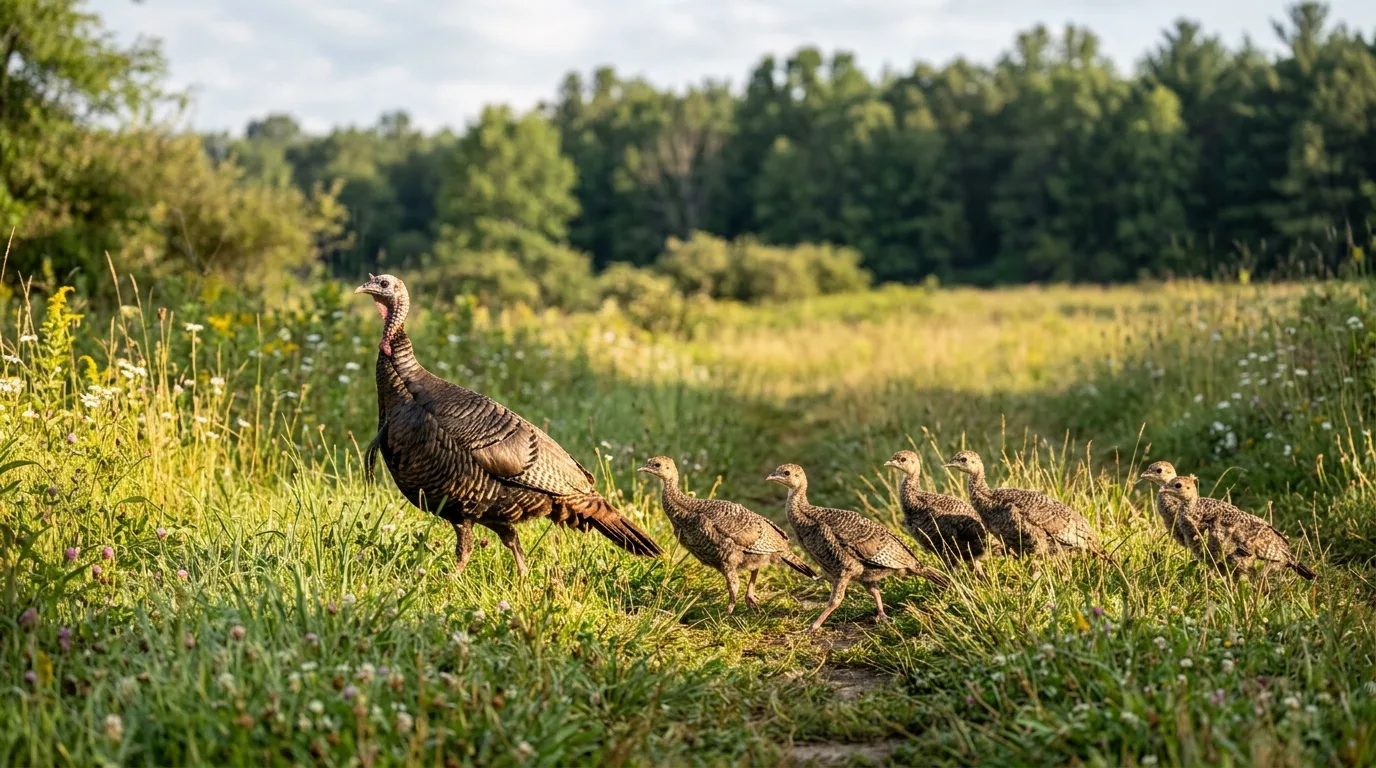
Here's the number that should drive everything you do with turkeys and cameras this summer: roughly two poults per hen. That's the line most turkey managers draw between a flock that's holding its own and one that's quietly shrinking. Below it for a few years running and your birds are on the way down, no matter how many gobblers you heard last April.
A wild turkey trail camera is how you find out which side of that line your ground is on. Not by counting gobbles in the spring — gobbling tells you how many toms survived to breed, not how many young birds will be there next fall. The number that predicts next year's flock is generated in July and August, when hens are walking their broods through open ground and you can actually count how many poults made it. Get cameras in the right places during those weeks and you can run a credible turkey brood survey on your own property, read your flock's age and sex structure through the whole year, and make management calls grounded in something better than a hunch.
This is a guide for landowners and managers who want to do exactly that. We'll cover the brood survey and the recruitment ratio it produces, how to read flock structure across the seasons, where to actually put the cameras, and — the part most people skip — what the numbers do and don't tell you once you have them.
Why brood data is the number that matters
Turkey populations don't rise and fall because of how many adults die. They rise and fall on reproduction. A decade-long study of 942 GPS-tagged hens across Louisiana, Georgia, and South Carolina found that adult hen survival stays "relatively strong for a ground-nesting bird" — reproductively active hens survived the breeding season at about 67 to 69 percent, non-nesting hens at about 76 percent. That's a real cost of nesting, but it's not catastrophic. The researchers' conclusion is the important part: because hen survival holds up even where turkey numbers are falling, "current population challenges may be driven more by nest success and poult survival than by adult hen mortality".
The NWTF puts it even more bluntly, and it's worth tattooing on the inside of your eyelids before you blame the coyotes: "production, not predation, drives turkey populations". Predators absolutely kill nests and poults — raccoons, opossums, snakes, hawks, bobcats, the whole cast — but in good nesting and brood-rearing habitat, hens can hide their nests and poults can stay out of sight. Where production collapses, it's usually because the habitat isn't there to let hens succeed in the first place.
So the question a manager actually needs answered every year is: how many young birds did my hens recruit into the fall population? As Nebraska's Luke Meduna told the NWTF, "Nest success and summer brood survival is generally the primary factor influencing wild turkey population trends. Information on summer brood survival is essential for sound turkey management". That's the entire case for brood monitoring in one sentence.
And this is exactly the kind of question cameras were made for. A statewide network of more than 2,000 community-science trail cameras in Wisconsin (the Snapshot Wisconsin project) was used to estimate turkey productivity from 38,671 photo triggers over five summers — the first study to pull recruitment metrics from trail cameras alone at that scale. Its takeaway: "trail cameras can be used to remotely index wild turkey productivity at spatial and temporal scales that would not otherwise be possible with traditional field methods". What a state agency does with 2,000 cameras, you can do in miniature on your few hundred acres.
What a state agency does with 2,000 cameras, you can do in miniature on your few hundred acres.
Running a brood survey: timing, what to count, and the ratio
A brood survey is gloriously low-tech in concept. You record every group of turkeys you see during late summer, classified into hens, poults, and gobblers, and you do a little division. State agencies have been doing it this way for decades — Missouri since 1959, Georgia since 1978, South Carolina since the early 1980s. The same method works whether you're driving survey routes for a state or reading photos off your own cameras.
Get the timing right. This is the single most common mistake. You survey in mid-to-late summer, not at hatch. Most eastern hens nest in April and May, but you wait until July and August to count, because by then the poults that were going to die mostly have, and what you're left with is the cohort that actually survived to enter the fall population. Survey windows vary a little by state and latitude:
- South Carolina runs July 1–August 29.
- Indiana runs July 1–August 31, calculating a Production Index of total poults divided by total adult hens.
- Florida starts earlier, June 1–August 31, because Florida turkeys begin nesting in late February.
- The national standardized protocol adopted by the NWTF Technical Committee restricts observations to July–August.
Pick the window your state uses and stick to it every year — consistency is what makes year-over-year comparison meaningful.
Count hens and poults; ignore the gobblers. During summer, adult gobblers play no part in raising young — they're off in bachelor groups or wandering solo — so most surveys tell you not to report them at all. What you record is the number of adult hens and the number of poults in each distinct group. Just as important, and routinely forgotten: record the hens you see with no poults at all. A hen with an empty nest is data. Complete brood loss is common, and a survey that only logs the happy families wildly overstates how well your birds are doing.
A few rules keep the data honest. Report each sighting separately rather than lumping a day's observations together. Don't record what you suspect is the same group twice in the same month. And know that by mid-to-late August, poults are roughly two-thirds the size of an adult, and a juvenile male (a jake) can be about the size of an adult hen — so late-summer groups get genuinely hard to classify. We'll come back to that, because it's where cameras earn their keep.
Then do the division. The core metric goes by a few names — poult-per-hen ratio (PPH), Total Recruitment Ratio (TRR), Production Index — but it's the same idea: total poults divided by total hens (successful and unsuccessful alike). South Carolina calls it the TRR and explains why it's the right number: "This annual index is the most practical measure of productivity because it considers successful hens, unsuccessful hens, and poult survival". It folds three things — did she nest, did the nest hatch, did the poults live — into one figure you can track across years.
What the ratio means (and where the thresholds get fuzzy)
So you've got a number. Say it's 1.8. Is that good?
The most widely used rule of thumb comes from South Carolina and is echoed across the Southeast: four or more poults per hen is excellent, three is good, two is fair and considered the break-even point, and below two is poor. Dr. Michael Chamberlain of the University of Georgia frames it the same way for the NWTF: "2.0 [poults per hen] is considered just enough to sustain populations. Ideally, we'd see 3.0 or more poults per hen, which indicates a growing population". Virginia's plan draws the same line — "ratios of above 2 pph indicates populations are stable or increasing, while pph ratios below 2 suggest that populations may be declining".
Here's where I'd push back on treating 2.0 as gospel, and the sources back the pushback. First, the threshold isn't perfectly fixed. The 2022 South Carolina report described poor as "one or less poults per hen" rather than below two, and Virginia explicitly cautions that "these benchmarks may not hold true as populations have expanded in many areas" — because when hen survival is high, productivity matters less to whether the population holds, and when hen survival is low, it matters more.
Second, the baseline genuinely differs by region. The national survey's first six years found expected poult-per-hen values were higher in the Northeast (4.2), Midwest (3.2), and West (3.9) than in the Southeast (2.6). A ratio of 2.5 means something very different in South Carolina than in New York. So don't import another region's number as your target — anchor to your own state's long-term average and watch the trend.
And the trends are the real story. Across the Southeast, the numbers have been grim and remarkably consistent:
| State / scope | Recent recruitment | Long-term context |
|---|---|---|
| South Carolina, 2024 | 1.6 TRR (slight uptick, still "poor") | Pre-1988 avg 3.5; post-1988 avg 2.1 — a 40% drop |
| South Carolina, 2023 | 1.2 TRR — all-time low since 1982 | 66% of hens had no poults |
| South Carolina, 2022 | 1.3 TRR — matched the 2013 record low | 64% of hens had no poults |
| Virginia, 2023 | 1.8 poults/hen, second-lowest on record | Long-term avg 2.4; 2018 low was 1.6 |
| Georgia | ~1.5 pph, 10-year average | Well below the 2.0 break-even |
Look at what's driving those numbers, because it points straight at the management problem. In South Carolina, "average brood sizes of 3.5 to 4 poults have remained consistent over time" — successful hens still raise a respectable brood. The collapse is in the share of hens that succeed at all: 56 percent had no poults in 2024, and that figure averaged 59 percent over five years. The national analysis found the same thing at continental scale — productivity variation "arose from differences in the probability of females observed without broods... rather than brood size". The bottleneck isn't how many eggs hatch into a brood; it's how many hens get a brood on the ground and keep it alive through the first couple of weeks. That's a nesting-and-early-brood habitat problem, which is the one lever a landowner can actually pull.
The bottleneck isn't how many eggs hatch into a brood; it's how many hens get a brood on the ground and keep it alive through the first couple of weeks.
Reading flock structure through the year
Brood data is the headline, but a camera left out year-round tells you the rest of the story — and turkey society reorganizes itself so completely across the seasons that the same camera shows you a different flock every couple of months. Knowing what you're supposed to be seeing, and when, is half of reading the photos correctly.
Winter is when turkeys are most gregarious, and the flocks are sex-segregated. As Chamberlain describes it, "Winter flocks are segregated by sex, with hens hanging out in large flocks and toms usually in smaller flocks". Jakes — last year's young males, the teenagers of the flock — form their own groups but tend to shadow the hen flocks, often showing up at the same feeding areas and occasionally throwing their weight around to assert dominance. So a winter camera on a food source might catch a dozen hens, a loose gang of jakes trailing them, and a separate trio of longbeards keeping their distance. In Pennsylvania's terms: "Old toms usually remain apart, in pairs or trios," while hens and their grown young run in flocks that can top 40 birds.
The spring breakup is dramatic and worth watching. As winter ends, those big flocks dissolve, and Chamberlain's description of the hen side is precise: "We go from seeing eight to ten hens together to only seeing three or four, and then hens transition from days of being gregarious and social to being the opposite". Groups don't just shrink — they relocate, sometimes shifting home range by miles to find nesting cover. This is why birds seem to vanish from a property overnight in early spring, or appear out of nowhere where you hadn't seen one in months. If your cameras go quiet in March, that's often dispersal, not disappearance.
By nesting season, hens go solitary and secretive. Once a hen starts laying, she spends most of the day alone, traveling to and from the nest on established routes and only associating with other hens at feeding sites. One of the Mossy Oak columns captures the moment two formerly companionable hens, sharing a food plot all winter, erupt into a dust-and-feathers fight on April 19 when one crowds the other — "Gone were the days of congenial and tight-knit hen groups". A lone hen hitting a feeding spot at the same time each day in late April is very likely nesting nearby.
Summer brings the brood flocks — and the merge. Hens lead poults to open, insect-rich ground to feed. Within a few weeks of hatching, family groups start combining: Pennsylvania notes that "when poults are about 3 weeks old, several family groups might merge to form a flock of hens and poults". Indiana calls these gatherings "gang broods" — several adult hens with multiple broods of varied ages. The NWTF uses the term creches and warns you'll commonly see "two or three brood hens with large gaggles of poults in tow," which makes per-hen counting tricky but is exactly the structure your survey needs to capture.
Fall is the reshuffle. Young males leave the brood flocks to form juvenile male groups, and the winter segregation begins again. Many of these same-sex groups, formed from siblings raised together, will stay together for life.
One genuinely useful thing a year-round camera teaches you is how stable individual birds and their patterns are. The author of the NWTF's year-round camera piece — who runs 54 cameras aimed at turkeys across 800-plus miles — has tracked the same two hens for seven years, always using the same trails to nest high in the mountains and returning with broods to the same area each summer. He's watched the same three dominant toms rule a single ridge for five years, running off every challenger before breeding — and notes pointedly that "not all of the dominant toms have the longest spurs or beards". That's the kind of insight you only get from leaving cameras up through the off-season.
That's the kind of insight you only get from leaving cameras up through the off-season.
Telling them apart on camera
Reading flock structure depends on classifying birds correctly, and a camera frame — sometimes a fast one — is a tougher test than a spotting scope. The basics, from Tennessee's identification guide built specifically for survey observers:
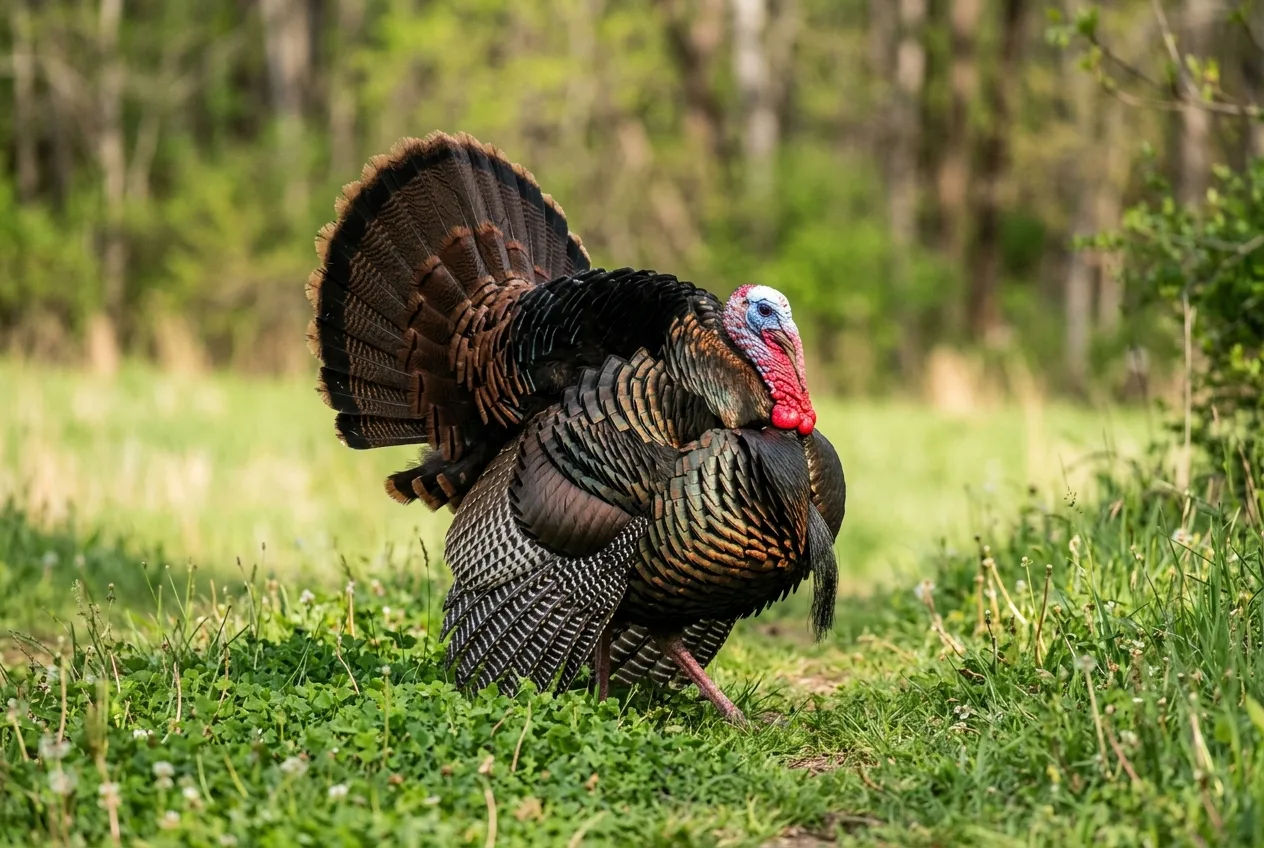
- Gobblers (adult toms) look dark, almost black, with a bronze or metallic sheen in sunlight; a bare red head sometimes flushed blue and white; prominent wattles and caruncles; and a beard 7–9 inches or longer. Mature toms stand 2½ to 3 feet tall and weigh 18–25 pounds.
- Jakes (year-old males) look like gobblers but noticeably smaller, with less-feathered red heads and a short beard under 6 inches. A reliable tell on camera: their tail fan has the central feathers sticking up above the rest, and their spurs are short and nubby.
- Hens are browner with much less iridescence, a blue-gray feathered head, and 8–12 pounds of body. Only about 5–10 percent of hens carry a beard, and it's thinner and often kinked.
For poults, that same Tennessee guide gives a three-class system that's the best camera-ready aging tool I've seen:
| Class | Age | Size and look |
|---|---|---|
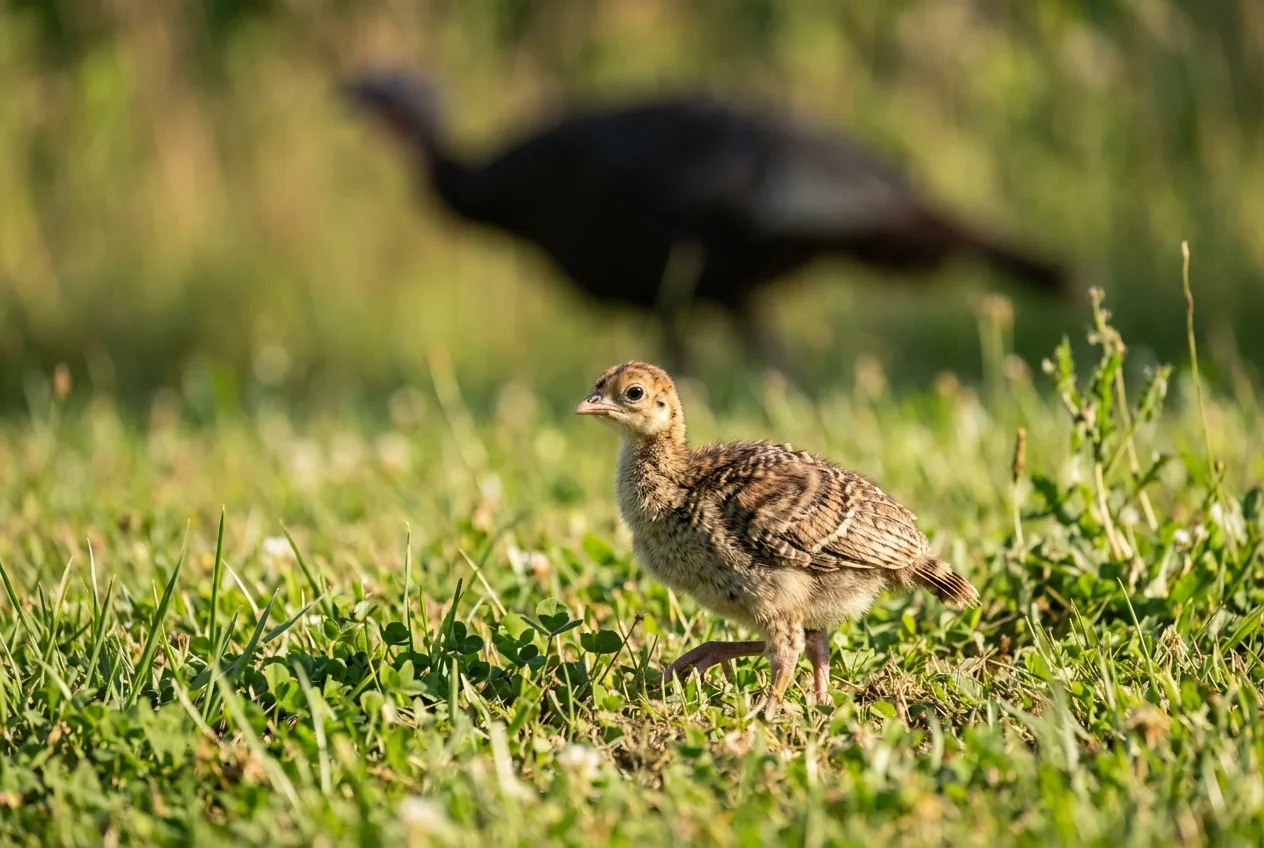
| Class 1 | ≤1 week | Under 5–6 inches tall, downy "puff balls" about the size of your fist |
| Class 2 | 2–5 weeks | 6–10 inches, "all wings," Blue Jay-sized; can flutter into low cover |
| Class 3 | 6–8+ weeks | 10–12+ inches, visible tail fan and barred wing feathers, crow- or chicken-sized |
By eight weeks they're growing adult-type body feathers and running maybe half the hen's size, closing fast by summer's end. And here's the honest limitation, straight from the same agency: "Late in the summer it can be very challenging to determine if a group of similar-sized turkeys is a flock of hens without poults or a hen and her older-age-class brood". When you can't tell, the right answer is to log them as unknown — not to guess in the direction you're hoping for.
Two more details help when the head and beard aren't visible. Tracks: a print larger than about 4¼ inches from heel pad to the tip of the middle toe is almost certainly a male. Droppings: male turkey droppings tend to be J-shaped, female droppings spiral or curlycue-shaped — handy when you're scouting a site for camera placement, and worth knowing alongside the rest of your Animal Tracks Identification: A Field Guide to Common Footprints.
When you can't tell, the right answer is to log them as unknown — not to guess in the direction you're hoping for.
Where to put the cameras
Turkeys aren't deer, and a camera setup built for whitetails will miss them. The fixes are specific.
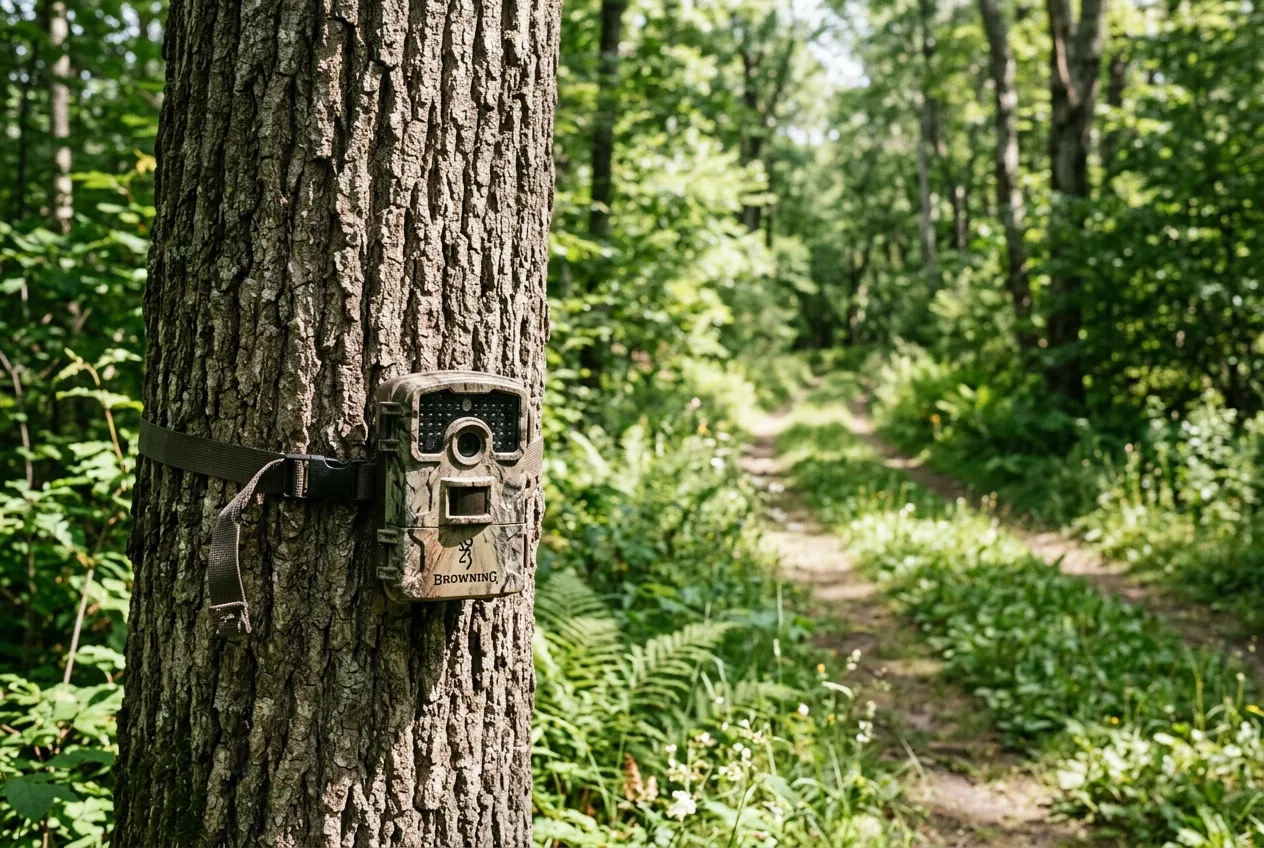
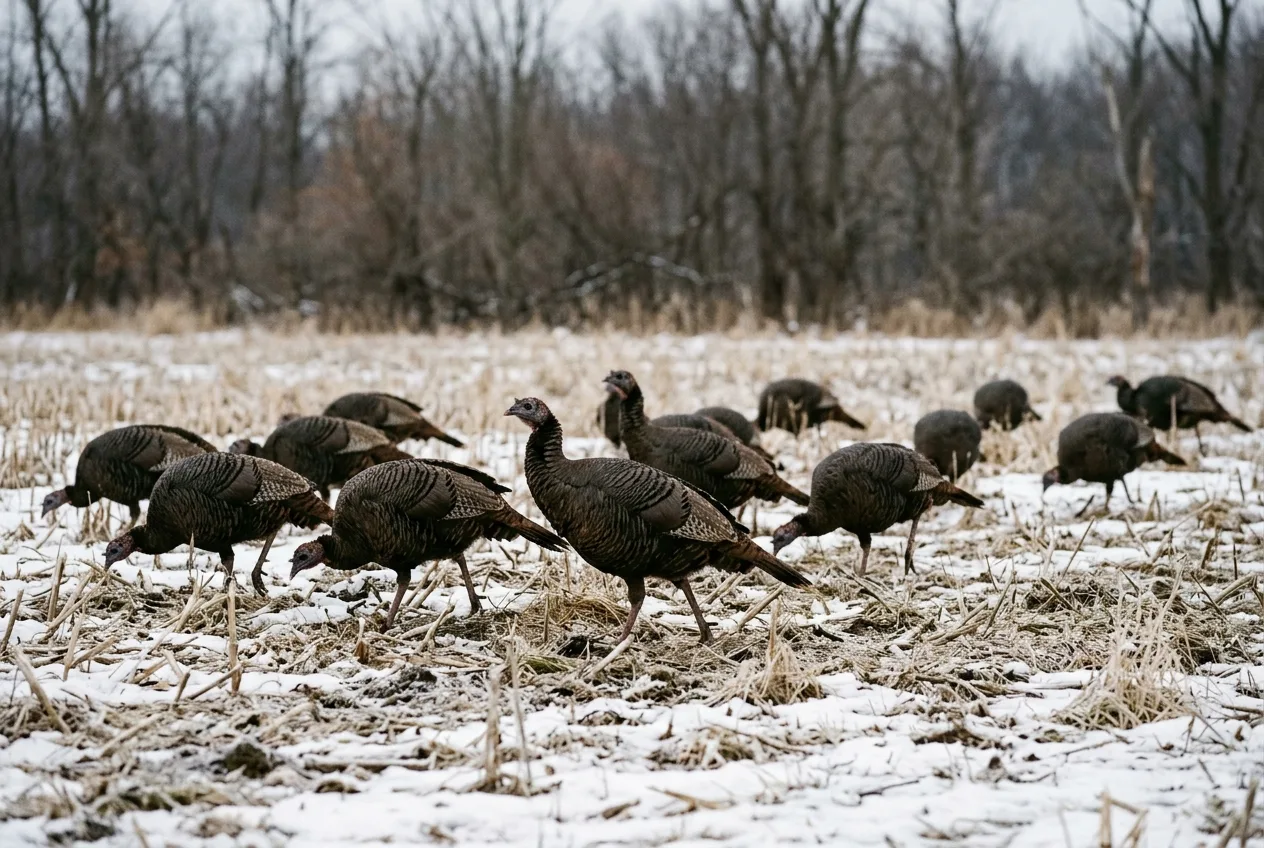
Open fields and food plots: use time-lapse, not just motion. Turkeys spend their days in open, insect-rich ground, and they'll often be feeding or strutting well beyond your camera's trigger range. As Exodus's Chad Sylvester told MeatEater, "When you're talking field edges and other openings, there is no better setting than time-lapse" — set it to fire on a schedule through the day so you capture a strutting tom 200 feet away who never trips the sensor. You then scroll the images in order, like stop-motion, to see exactly when birds arrive, how they enter, and how they leave. State research mirrors why open ground matters: hens take broods to forest clearings, field edges, log landings, and rights-of-way precisely because sunlight there drives the insect life poults depend on.
Trails and travel routes: use video. In tighter quarters, time-lapse just fills your card with empty woods. MeatEater's Tony Peterson runs two-minute video clips here, and the reasoning is sharp: "the lead hen often sets off the camera, and then whoever is on her tail will eventually walk through" — plus you capture audio, with other birds sounding off in the clip. Like deer, "longbeards tend to choose the easiest path from point A to B," so log roads, two-tracks, and ridge spines are high-odds sets. The NWTF camera author goes further and runs video mode exclusively, year-round: "A 15-second video reveals much more than a still image," and for behavioral study he programs runs of at least two minutes.
Whatever the mode, kill the trigger delay. Turkeys move through fast, and a camera with a long recovery lag will photograph the empty trail a beat after the flock passes. Sylvester's rule: "always check the trigger delay on your camera. Cut it down to the quickest option" — typically one to five seconds.
Mount low, and clear the lens lane. This is the least intuitive tip and one of the most valuable. The NWTF author positions cameras close to the ground — sometimes strapped to a rock or a movable chunk of wood — because a low angle captures the vocalizations and close detail that let him identify individual birds: "Low trail camera positioning also allows you to identify individual birds". In leafy bottoms, clip the overhanging limbs so a solar panel keeps the camera powered; in open country, just rig the panel.
For roosts, find the sign and set up off it. Turkeys roost in mature, open-crowned trees with horizontal limbs, near water and open feeding areas. You find a roost the old way — by the litter of droppings and feathers under the canopy. Breeding-season toms favor what Chamberlain calls "hub roosts" that "provide toms with the perfect mixture of protection, the ability to project gobbles across the area around them, and access to hens". Hens keep hub roosts too, sited near water, open ground, and lightly traveled roads. A camera covering the flight-down approach to a known roost is a reliable producer — but mind the disturbance: "There's always a risk that birds won't return if disturbed on or near a roost," so do your hanging and any habitat work at midday when the birds are off feeding.
A word on bait. It's tempting to dump corn to pull birds past a camera, but baiting can do more harm than good. Pennsylvania's biologists argue against it on biology alone: feeding "might actually pose a hazard by unnaturally concentrating a local population, thus increasing the danger of poaching and disease transmission, and giving predators an unnatural advantage". Lean on natural concentration points — fields, travel routes, roost approaches — instead.
Turning the data into management
Numbers are only worth collecting if they change a decision. Here's how brood data actually feeds management, and where its limits are.
At the agency level, the poult-per-hen ratio is a leading indicator. Chamberlain: "These ratios allow managers to predict how populations will look during subsequent years". When Georgia's long-term average slid to roughly 1.5, the state didn't shrug — it "made significant changes to our spring turkey regulations, including adjusting season dates and bag limits". Virginia frames the same logic explicitly: the brood survey is "an index to productivity of wild turkey reproduction and can assist in making management decisions". Brood surveys don't act alone; they sit alongside harvest data, winter sighting surveys, and avid-hunter observations to build the population picture. It's the same logic landowners already apply to deer How Many Deer Are on Your Land? Running a Trail Camera Survey, just tuned to a bird whose reproduction swings far harder year to year.
On your own ground, the move is the same one scaled down: track your trend, compare it to your state's, and if you're running below break-even year after year, the highest-leverage response is habitat — specifically nesting and early brood-rearing cover, because that's where the data says the failure is. The NRCS habitat leaflet is explicit that brood habitat — "open riparian woodlands, savannas, and forest openings of one-half to three acres" with herbaceous cover that supports insects but stays open enough for poults to move — is what limits recruitment. And insects aren't optional: "poult survival will be low in habitats that do not support insects". Prescribed fire, timber thinning to open the canopy, and maintaining permanent grassy openings are the practical levers the sources point to.
Now the limits, because a manager who oversells these numbers will get burned. The ratio is an index, not a census — it tells you the direction and rough magnitude of productivity, not an exact head count. Sample size matters enormously. Virginia's statewide survey generates a long-term average of just 141 observations a year, "below the 200 observations that are needed to draw significant statistical inferences". On a single property your sample is smaller still, so trust multi-year trends and treat any single year as noise. Detection is uneven. The Wisconsin camera study cautioned that its recruitment estimates ran low compared with traditional surveys, "potentially due to lower detection rates of poults compared to hens on trail cameras" — small poults are simply harder to catch on camera than the adult leading them. And comparing across places is genuinely hard: protocols "have changed over time and differed among agencies," which is exactly why USGS researchers built statistical models (and released the R code, CC0-licensed) to make multi-state turkey data comparable at all. The honest version of brood monitoring is humble about precision and confident about trend. That's the right posture.
The honest version of brood monitoring is humble about precision and confident about trend.
Frequently asked questions
When is the best time to run a turkey brood survey?
Mid-to-late summer — most states use July 1 through late August, and Florida starts June 1 because its turkeys nest earlier. You wait until then so you're counting the poults that actually survived to enter the fall population, rather than newly hatched birds that may not make it.
What is a good poult-to-hen ratio?
The common benchmark is about two poults per hen as the break-even point, three as good, and four or more as excellent; below two for several years signals a declining population. But baselines differ by region — the Northeast's expected ratio runs near 4.2 versus about 2.6 in the Southeast — so compare to your own state's long-term average rather than a single national number.
Should I report gobblers in my brood survey?
No. Adult gobblers take no part in raising young in summer, so most state surveys ask you to leave them out and record only adult hens and poults. Do record hens that have no poults, though — complete brood loss is common and counts as real productivity data.
What camera settings work best for turkeys?
Use time-lapse on open fields and food plots to capture birds beyond your trigger range, and video mode on trails so the lead hen sets off the camera and trailing birds and audio come through. Cut the trigger delay to one to five seconds, and mount cameras low to the ground to help identify individual birds and pick up their vocalizations.
Can trail cameras really estimate turkey productivity, or is that just for biologists?
They can. Trail cameras have been used to index turkey productivity at scales traditional field methods can't reach. The same poult-per-hen method scales down to a single property — just expect cameras to under-detect small poults, and trust the multi-year trend over any one season.
Why are turkey numbers declining if predators are controlled?
Because production, not predation, drives turkey populations. Adult hen survival stays strong, so declines trace mainly to poor nest and poult survival — usually a shortage of quality nesting and brood-rearing habitat — rather than to predators killing adults.